


Page 49 - (DK) Ocean - The Definitive Visual Guide
P. 49
THE EVOLUTION OF THE OCEANS              47


                   Cambrian Ordovician Silurian  Devonian Carboniferous Permian  Triassic  Jurassic  Cretaceous  Paleogene Neogene  Sea-level Change   change of 100–200m (330–655ft) over a
                                                          Sea level has constantly changed through
                                                                                               few tens of thousands of years.  The rate of
                                                          history, being up to 400m (1,300ft) higher
                                                    SEA LEVEL  M/FT
              22/72                                       in the past. One of the factors controlling   sea-floor spreading also affects global sea
                                                                                               levels and has outweighed climatic factors at
                                                          sea level is the global climate. Thermal
              20/68                                  PRESENT LEVEL AT 0  expansion of ocean water increases global   some times. Faster-spreading ridges reduce
              18/64                                       sea level by about 7.5cm (3in) for every 1˚C  the volume of the ocean basins as the
              16/61                                       (1.8˚F) increase in temperature. The transfer   younger, hotter crust rises higher, causing
                                                          of water between ice caps and the oceans   sea levels to rise (see p.88). Local changes
              14/57                                       during glacial cycles accounts for a global   also occur as a result of crustal movement.
                                                   300/980
              12/54
                                                   200/660  MEDITERRANEAN BASIN HISTORY
              10/50                                100/330
                TEMPERATURE ˚C/˚F                  0/0


                                                   -100/-330
                 542  500  450  400  350  300  250  200  150  100  50  0
                           MILLIONS OF YEARS AGO

             TEMPERATURE AND SEA LEVEL
             Over the last 100 million years, climate has controlled sea levels,
             and these (in blue on graph) have dropped as the climate has   1  The Mediterranean was isolated   2  21,000 years ago, sea levels were   3  100,000 years ago, water from melting
             cooled (temperature in yellow). At other times, low sea levels   from the Atlantic by the closure of the   120m (390ft) lower than they are today   ice started to flood the continental
             were due to reduced rates of sea-floor spreading.  Strait of Gibraltar five million years   due to water being locked up in ice caps  shelves exposed during the glacial,
                                                          ago, and evaporated to a salty desert.  at the height of the last glacial.  leaving today’s familiar shoreline.
             Sedimentary Basins

             Most of the world’s sedimentary rocks were   BASINS AND OILFIELDS
             laid down in water over continental shelves   Sedimentary basins are found on
             or in inland seas. The movements of the   the continental shelves and
             continents and changes in sea level have   adjacent ocean floor, but
                                                    also well inland where
             determined where this deposition occurred    areas were once                                                       PA CIFIC
             at particular times, and many former marine   covered with water.
                                                                                                                                 OCEAN
             sedimentary basins are now far inland.
                                                                           PA CIFIC            ATLANTIC OCEAN
               Oil and gas deposits are found in marine   KEY
             sedimentary rocks, the result of animal and   onshore          OCEAN
                                                        sedimentary
             plant remains decomposing and then being   deposits                                                   INDIAN
             buried and compressed. About 30 per cent
                                                        offshore                                                   OCEAN
             of the world’s oil and gas production comes   sedimentary deposits
             from offshore fields, but many offshore basins                                      SOUTHERN OCEAN
             remain to be explored.                           Oil and gas deposits


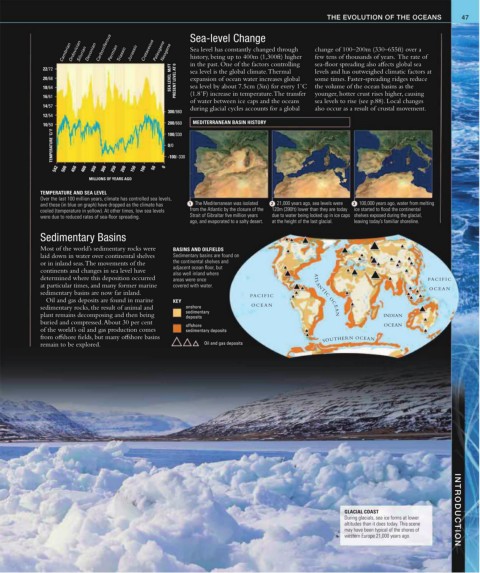
                                                                                                        GLACIAL COAST                    INTRODUCTION
                                                                                                        During glacials, sea ice forms at lower
                                                                                                        altitudes than it does today. This scene
                                                                                                        may have been typical of the shores of
                                                                                                        western Europe 21,000 years ago.

