


Page 69 - (DK) Ocean - The Definitive Visual Guide
P. 69
OCEANS AND CLIMATE            67


             Carbon in the Oceans                                   FORAMINIFERAN
                                                                    SHELL
             The oceans contain Earth’s largest store of carbon dioxide (CO )—the main
                                                              2
             greenhouse gas implicated in global warming. Huge amounts of carbon are held
             in the oceans, some in the form of CO  and related substances that readily convert
                                           2
             to CO , and some in living organisms. The oceanic CO  is in balance with the
                  2                                      2
             atmospheric content of the same gas. For many years, the oceans have been alkaline,
             and acted as an important store for the excess CO  released by human activity.
                                                    2
             Biological and chemical processes turn some of this CO  into the calcium carbonate
                                                        2
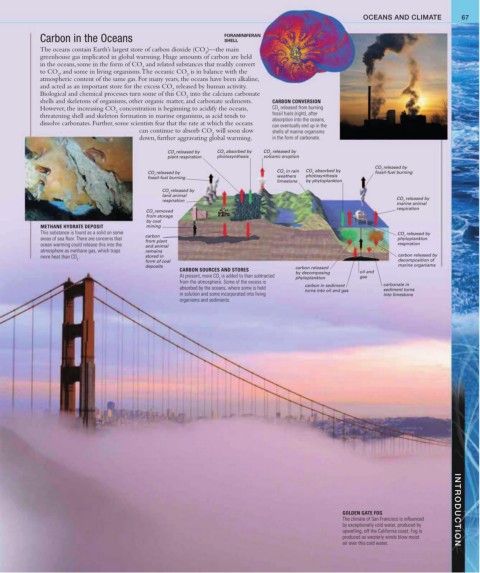
             shells and skeletons of organisms, other organic matter, and carbonate sediments.   CARBON CONVERSION
             However, the increasing CO  concentration is beginning to acidify the oceans,   CO  released from burning
                                                                                    2
                                   2                                              fossil fuels (right), after
             threatening shell and skeleton formation in marine organisms, as acid tends to   absorption into the oceans,
             dissolve carbonates. Further, some scientists fear that the rate at which the oceans   can eventually end up in the
                                          can continue to absorb CO  will soon slow   shells of marine organisms
                                                                2
                                          down, further aggravating global warming.  in the form of carbonate.
                                                   CO released by   CO  absorbed by   CO  released by
                                                     2             2             2
                                                   plant respiration   photosynthesis  volcanic eruption
                                                                                                                 CO released by
                                                                                                                   2
                                             CO released by                        CO  in rain   CO absorbed by   fossil-fuel burning
                                                                                              2
                                                                                     2
                                               2                                   weathers   photosynthesis
                                             fossil-fuel burning
                                                                                   limestone  by phytoplankton
                                                 CO released by
                                                   2
                                                 land animal
                                                 respiration                                                           CO  released by
                                                                                                                         2
                                                                                                                       marine animal
                                                                                                                       respiration
                                            CO removed
                                              2
                                            from storage
                                            by coal
             METHANE HYDRATE DEPOSIT        mining
             This substance is found as a solid on some                                                                CO  released by
                                                                                                                         2
             areas of sea floor. There are concerns that   carbon                                                       phytoplankton
                                            from plant
             ocean warming could release this into the   and animal                                                    respiration
             atmosphere as methane gas, which traps   remains
             more heat than CO .            stored in                                                                   carbon released by
                        2                                                                                               decomposition of
                                            form of coal
                                            deposits                                     carbon released                marine organisms
                                                      CARBON SOURCES AND STORES                             oil and
                                                      At present, more CO  is added to than subtracted   by decomposing   gas
                                                                  2                      phytoplankton
                                                      from the atmosphere. Some of the excess is                   carbonate in
                                                      absorbed by the oceans, where some is held    carbon in sediment   sediment turns
                                                                                            turns into oil and gas
                                                      in solution and some incorporated into living                into limestone
                                                      organisms and sediments.


                                                                                                       GOLDEN GATE FOG                   INTRODUCTION
                                                                                                       The climate of San Francisco is influenced
                                                                                                       by exceptionally cold water, produced by
                                                                                                       upwelling, off the California coast. Fog is
                                                                                                       produced as westerly winds blow moist
                                                                                                       air over this cold water.

