


Page 68 - (DK) Ocean - The Definitive Visual Guide
P. 68
66      CIRCULATION AND CLIMATE


               Oceans and Climate


               THE OCEANS HAVE A PROFOUND INFLUENCE on the world’s climate, most strikingly
               in the way they absorb solar energy and redistribute it around the world in warm
               surface currents. Cold currents also produce local climatic effects, while alterations
               in currents are associated with climatic fluctuations such as      SOLAR HEATING
               El Niño (see p.68). The future behavior of the oceans is crucial   The surface layers of the oceans
                                                                                  absorb about half the solar
               to the future course of climate change, as they are an important  energy that reaches Earth.
               store for carbon dioxide, the principal greenhouse gas.            Currents move this from the
                                                                                  equator toward the poles at a
                                                                                  rate of several billion megawatts.

               Warm Currents
               Five or six major surface currents (see p.58) carry heat away from the
               tropics and subtropics toward the poles, giving some temperate regions a
               warmer climate than they would otherwise enjoy. A prime example is
               the effect of the warm Gulf Stream and its extension, the North Atlantic
               Drift, on Europe. The North Atlantic Drift carries heat originally
               absorbed in the Caribbean Sea and Gulf of Mexico across the Atlantic,
               where it is released into the atmosphere close to the shores of France,
               the British Isles, Norway, Iceland, and other parts of northwestern
               Europe. As the prevailing westerly winds blow this warmed air over land,
               these countries benefit from a milder climate than equivalent regions at
               similar, or even lower latitudes, on the western side of the Atlantic. For
               example, winter temperatures are typically
               higher in Reykjavik, the capital of Iceland,   BALMY BEACHFRONT
               than in New York. Similarly, in the northwest   Penzance, in southwest England,
               Pacific, the Kuroshio Current warms the   has a mild climate that supports
                                                    subtropical vegetation—the
               southern part of Japan, while in the extreme   effect of the North Atlantic Drift
               southwest Pacific, the East Australian Current  is to raise temperatures here by
               gives Tasmania a relatively mild climate.  about 9˚F (5˚C).


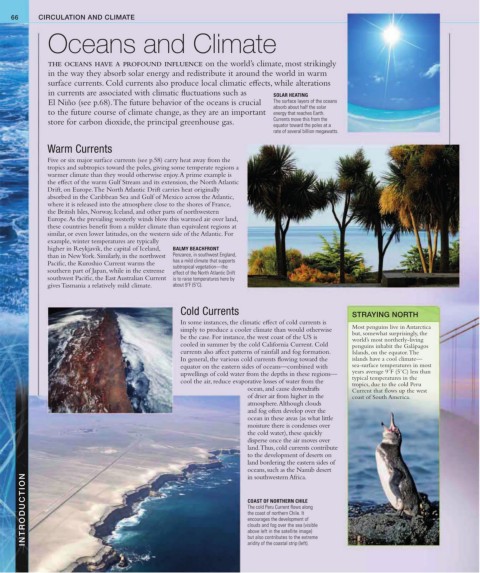
                                                       Cold Currents                                      STRAYING NORTH

                                                       In some instances, the climatic effect of cold currents is
                                                       simply to produce a cooler climate than would otherwise   Most penguins live in Antarctica
                                                                                                          but, somewhat surprisingly, the
                                                       be the case. For instance, the west coast of the US is    world’s most northerly-living
                                                       cooled in summer by the cold California Current. Cold   penguins inhabit the Galápagos
                                                       currents also affect patterns of rainfall and fog formation.    Islands, on the equator. The
                                                       In general, the various cold currents flowing toward the   islands have a cool climate—
                                                       equator on the eastern sides of oceans—combined with   sea-surface temperatures in most
                                                       upwellings of cold water from the depths in these regions—  years average 9˚F (5˚C) less than
                                                       cool the air, reduce evaporative losses of water from the   typical temperatures in the
                                                                                                          tropics, due to the cold Peru
                                                                           ocean, and cause downdrafts    Current that flows up the west
                                                                           of drier air from higher in the   coast of South America.
                                                                           atmosphere. Although clouds
                                                                           and fog often develop over the
                                                                           ocean in these areas (as what little
                                                                           moisture there is condenses over
                                                                           the cold water), these quickly
                                                                           disperse once the air moves over
                                                                           land. Thus, cold currents contribute
                                                                           to the development of deserts on
                                                                           land bordering the eastern sides of
                                                                           oceans, such as the Namib desert
        INTRODUCTION                                                       COAST OF NORTHERN CHILE
                                                                           in southwestern Africa.


                                                                           The cold Peru Current flows along
                                                                           the coast of northern Chile. It
                                                                           encourages the development of
                                                                           clouds and fog over the sea (visible
                                                                           above left in the satellite image)
                                                                           but also contributes to the extreme
                                                                           aridity of the coastal strip (left).

