


Page 67 - (DK) Ocean - The Definitive Visual Guide
P. 67
65


             Ocean Evaporation and Precipitation

             A total of 104,000 cubic miles (434,000 cubic kilometers)
             of water evaporates from the oceans per year. Of this,
             95,500 cubic miles (398,000 cubic kilometers) falls
             back into the sea as precipitation (rain, snow, sleet, and
             hail). The remainder is carried onto land as clouds and
             moisture. Evaporation and precipitation are not evenly
             spread over the surface of the oceans. Evaporation rates
             are greatest in the tropics and lowest near the poles.
             High rates of precipitation occur near the equator
             and in bands between the latitudes of 45º and 70º
             in both hemispheres. Drier regions are found on the
             eastern sides of the oceans between the latitudes of
             approximately 15º and 40º.


              PEOPLE
              SENECA THE YOUNGER
                                    In his book Natural Questions, the Roman
                                    statesman, dramatist, and philosopher
                                    Seneca the Younger (4 bc–ad 65) pondered
                                    why ocean levels remain stable despite the
                                    continuous input of water from rivers and
                                          rain. He argued there must be
                                              mechanisms by which water
                                                is returned from the sea
                                                to the air and land and
                                                 proposed an early version
                                                 of the hydrologic cycle
                                                to explain this.


             Freshwater Inflow

             The 8,500 cubic miles (36,000 cubic kilometers) of water lost from
             the oceans each year by evaporation and transport onto land is
             balanced by an equal amount returned from land in runoff. Just
             20 rivers, including the Amazon and some large Siberian rivers,
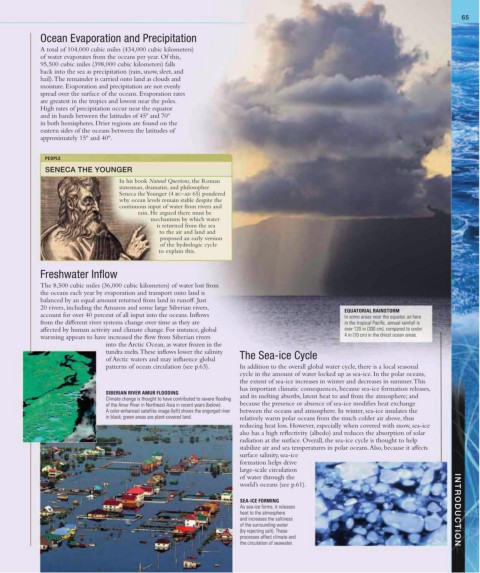
                                                                                                        EQUATORIAL RAINSTORM
             account for over 40 percent of all input into the oceans. Inflows                          In some areas near the equator, as here
             from the different river systems change over time as they are                              in the tropical Pacific, annual rainfall is
             affected by human activity and climate change. For instance, global                        over 120 in (300 cm), compared to under
             warming appears to have increased the flow from Siberian rivers                            4 in (10 cm) in the driest ocean areas.
                                into the Arctic Ocean, as water frozen in the
                                tundra melts. These inflows lower the salinity   The Sea-ice Cycle
                                of Arctic waters and may influence global
                                patterns of ocean circulation (see p.63).  In addition to the overall global water cycle, there is a local seasonal
                                                                        cycle in the amount of water locked up as sea-ice. In the polar oceans,
                                                                        the extent of sea-ice increases in winter and decreases in summer. This
                                                                        has important climatic consequences, because sea-ice formation releases,
                                SIBERIAN RIVER AMUR FLOODING
                                Climate change is thought to have contributed to severe flooding   and its melting absorbs, latent heat to and from the atmosphere; and
                                of the Amur River in Northeast Asia in recent years (below).    because the presence or absence of sea-ice modifies heat exchange
                                A color-enhanced satellite image (left) shows the engorged river    between the oceans and atmosphere. In winter, sea-ice insulates the
                                in black; green areas are plant-covered land.   relatively warm polar oceans from the much colder air above, thus
                                                                        reducing heat loss. However, especially when covered with snow, sea-ice
                                                                        also has a high reflectivity (albedo) and reduces the absorption of solar
                                                                        radiation at the surface. Overall, the sea-ice cycle is thought to help
                                                                        stabilize air and sea temperatures in polar oceans. Also, because it affects
                                                                        surface salinity, sea-ice
                                                                        formation helps drive
                                                                        large-scale circulation
                                                                        of water through the
                                                                        world’s oceans (see p.61).

                                                                        SEA-ICE FORMING
                                                                        As sea-ice forms, it releases
                                                                        heat to the atmosphere                                           INTRODUCTION
                                                                        and increases the saltiness
                                                                        of the surrounding water
                                                                        (by rejecting salt). These
                                                                        processes affect climate and
                                                                        the circulation of seawater.

