


Page 66 - (DK) Ocean - The Definitive Visual Guide
P. 66
64      CIRCULATION AND CLIMATE


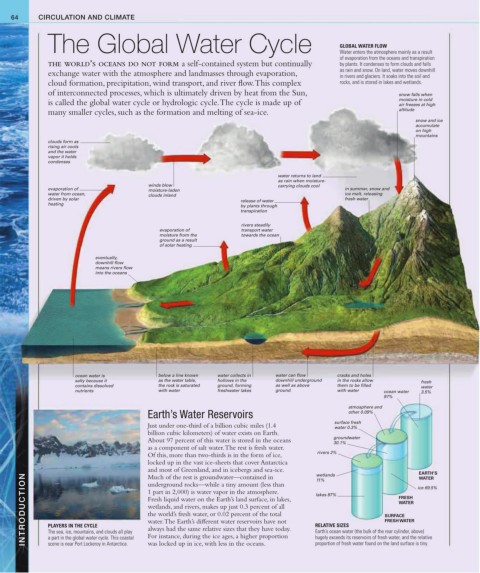
               The Global Water Cycle                                                                 GLOBAL WATER FLOW

                                                                                                      Water enters the atmosphere mainly as a result
                                                                                                      of evaporation from the oceans and transpiration
               THE WORLD’S OCEANS DO NOT FORM a self-contained system but continually                 by plants. It condenses to form clouds and falls
                                                                                                      as rain and snow. On land, water moves downhill
               exchange water with the atmosphere and landmasses through evaporation,
                                                                                                      in rivers and glaciers. It soaks into the soil and
               cloud formation, precipitation, wind transport, and river flow. This complex           rocks, and is stored in lakes and wetlands.
               of interconnected processes, which is ultimately driven by heat from the Sun,                            snow falls when
               is called the global water cycle or hydrologic cycle. The cycle is made up of                            moisture in cold
                                                                                                                        air freezes at high
               many smaller cycles, such as the formation and melting of sea-ice.                                       altitude
                                                                                                                             snow and ice
                                                                                                                             accumulate
                                                                                                                             on high
                                                                                                                             mountains
               clouds form as
               rising air cools
               and the water
               vapor it holds
               condenses
                                                                                    water returns to land
                                                                                    as rain when moisture-
                                             winds blow                             carrying clouds cool
               evaporation of                moisture-laden                                             in summer, snow and
               water from ocean,             clouds inland                                              ice melt, releasing
               driven by solar                                           release of water               fresh water
               heating                                                   by plants through
                                                                         transpiration

                                                                         rivers steadily
                                                evaporation of           transport water
                                                moisture from the        towards the ocean
                                                ground as a result
                                                of solar heating
                             eventually,
                             downhill flow
                             means rivers flow
                             into the oceans


                       ocean water is           below a line known   water collects in   water can flow   cracks and holes
                       salty because it         as the water table,   hollows in the   downhill underground   in the rocks allow    fresh
                       contains dissolved       the rock is saturated   ground, forming   as well as above   them to be filled    water
                       nutrients                with water        freshwater lakes  ground           with water    ocean water   3.5%
                                                                                                                   97%
                                                                                                         atmosphere and
                                             Earth’s Water Reservoirs                                    other 0.09%
                                                                                                     surface fresh
                                             Just under one-third of a billion cubic miles (1.4      water 0.3%
                                             billion cubic kilometers) of water exists on Earth.
                                             About 97 percent of this water is stored in the oceans   groundwater
                                                                                                    30.1%
                                             as a component of salt water. The rest is fresh water.
                                             Of this, more than two-thirds is in the form of ice,   rivers 2%
                                             locked up in the vast ice-sheets that cover Antarctica
                                             and most of Greenland, and in icebergs and sea-ice.   wetlands                  ice 69.5%
        INTRODUCTION  PLAYERS IN THE CYCLE   1 part in 2,000) is water vapor in the atmosphere.   RELATIVE SIZES    SURFACE
                                                                                                                              EARTH’S
                                             Much of the rest is groundwater—contained in
                                                                                               11%
                                                                                                                              WATER
                                             underground rocks—while a tiny amount (less than
                                                                                               lakes 87%
                                             Fresh liquid water on the Earth’s land surface, in lakes,
                                                                                                                        FRESH
                                             wetlands, and rivers, makes up just 0.3 percent of all
                                                                                                                        WATER
                                             the world’s fresh water, or 0.02 percent of the total
                                             water. The Earth’s different water reservoirs have not
                                                                                                                    FRESH WATER
                                             always had the same relative sizes that they have today.
               The sea, ice, mountains, and clouds all play
                                                                                               Earth’s ocean water (the bulk of the rear cylinder, above)
                                             For instance, during the ice ages, a higher proportion
               a part in the global water cycle. This coastal
                                                                                               hugely exceeds its reservoirs of fresh water, and the relative
                                             was locked up in ice, with less in the oceans.
                                                                                               proportion of fresh water found on the land surface is tiny.
               scene is near Port Lockeroy in Antarctica.

