


Page 19 - Amphibian
P. 19
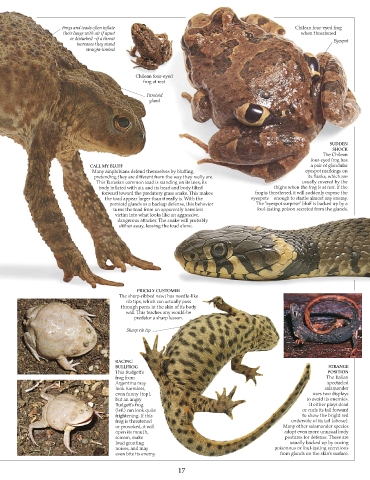
Frogs and toads often inflate Chilean four-eyed frog
their lungs with air if upset when threatened
or disturbed –if a threat Eyespot
increases they stand
straightlimbed
Chilean four-eyed
frog at rest
Parotoid
gland
SUDDEN
SHOCK
The Chilean
four-eyed frog has
CALL MY BLUFF a pair of glandular
Many amphibians defend themselves by bluffing, eyespot markings on
pretending they are different from the way they really are. its flanks, which are
This Eurasian common toad is standing on its toes, its usually covered by the
body inflated with air, and its head and body tilted thighs when the frog is at rest. If the
forward toward the predatory grass snake. This makes frog is threatened, it will suddenly expose the
the toad appear larger than it really is. With the eyespots – enough to startle almost any enemy.
parotoid glands as a backup defense, this behavior The “eyespot surprise” bluff is backed up by a
turns the toad from an apparently harmless foul-tasting poison secreted from the glands.
victim into what looks like an aggressive,
dangerous attacker. The snake will probably
slither away, leaving the toad alone.
PRICKLY CUSTOMER
The sharp-ribbed newt has needle-like
rib tips, which can actually pass
through pores in the skin of its body
wall. This teaches any would-be
predator a sharp lesson.
Sharp rib tip
RAGING
BULLFROG STRANGE
This Budgett’s POSITION
frog from The Italian
Argentina may spectacled
look harmless, salamander
even funny (top), uses two displays
but an angry to avoid its enemies.
Budgett’s frog It either plays dead
(left) can look quite or curls its tail forward
frightening. If this to show the bright red
frog is threatened underside of its tail (above).
or provoked, it will Many other salamander species
open its mouth, adopt even more unusual body
scream, make postures for defense. These are
loud grunting usually backed up by oozing
noises, and may poisonous or foul-tasting secretions
even bite its enemy. from glands on the skin’s surface.
1

