


Page 18 - Amphibian
P. 18
Protection from predators


        Amphibians have many enemies – each year millions are
        eaten by other animals. Although most amphibians produce
        poisonous chemicals in their skin, unlike snakes, spiders, and
        scorpions they lack the means of inflicting a poisonous bite or
        sting. An amphibian’s poison-defense (pp. 56–57) is usually
        a last resort and will only work if a predator tries to eat it.
        The main way in which an amphibian defends itself is
        with camouflage, by remaining hidden and undetected
        (pp. 20–21). If amphibians are disturbed, they will
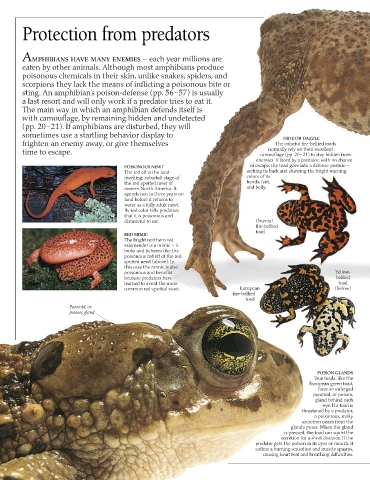
        sometimes use a startling behavior display to                                          HIDE OR DAZZLE
        frighten an enemy away, or give themselves                                          The colorful fire-bellied toads
                                                                                          normally rely on their excellent
        time to escape.                                                                camouflage (pp. 20–21) to stay hidden from
                                                                                      enemies. If faced by a predator, with no chance
                                          POISONOUS NEWT                            of escape, the toad goes into a defense posture –
                                          The red eft is the land-                 arching its back and showing the bright warning
                                          dwelling, subadult stage of              colors of its
                                          the red-spotted newt of                  hands, feet,
                                          eastern North America. It                and belly.
                                          spends two to three years on
                                          land before it returns to
                                          water as a fully adult newt.
                                          Its red color tells predators
                                          that it is poisonous and
                                          distasteful to eat.                         Oriental
                                                                                      fire-bellied
                                                                                      toad
                                          RED MIMIC
                                          The bright northern red
                                          salamander is a mimic – it
                                          looks and behaves like the
                                          poisonous red eft of the red-
                                          spotted newt (above). In
                                          this case the mimic is also
                                          poisonous and benefits                                                Yellow-
                                          because predators have                                                bellied
                                          learned to avoid the more                                              toad
                                          common red-spotted newt.              European                        (below)
                                                                              fire-bellied
                                                                                  toad
                        Parotoid, or
                        poison, gland


                                                                                                          POISON GLANDS
                                                                                                         True toads, like the
                                                                                                       European green toad,
                                                                                                          have an enlarged
                                                                                                         parotoid, or poison,
                                                                                                         gland behind each
                                                                                                            eye. If a toad is
                                                                                                     threatened by a predator,
                                                                                                         a poisonous, milky
                                                                                                     secretion oozes from the
                                                                                                 gland’s pores. When the gland
                                                                                               is pressed, the toad can squirt the
                                                                                              secretion for a short distance. If the
                                                                                      predator gets the poison in its eyes or mouth, it
                                                                                      suffers a burning sensation and muscle spasms,
                                                                                        causing heartbeat and breathing difficulties.

