


Page 20 - Amphibian
P. 20
SNACK ATTACK  Fast food
                                   Birds, fish, insects,
                                   spiders, mammals,
                                     and even other
                                   amphibians snack
                                  on amphibians! This   Most amphibians will eat almost any live food that
                                  French earthenware   they can manage to gulp down. Insects, spiders, snails,
                                  plate, c. 1560, shows
                                    a frog about to be   slugs, and earthworms form the main part of the diet for
                                   eaten by one of its
                                    main enemies– a   most adult amphibians. Larger species, like the ornate
                                       grass snake.  horned frog, will take larger prey, maybe even a mouse.
                                                   Some species are cannibals – cases of frog eat frog. There
                                                                are also specialist feeders – some smaller frogs
                                                                and toads eat only ants or termites, and one
                      Frog launching
                      itself toward                             species of Brazilian tree frog eats only berries.
                      prey
                                                                Aquatic amphibians, like the African clawed
                                                                toad (pp. 22–23), tend to hang just below the
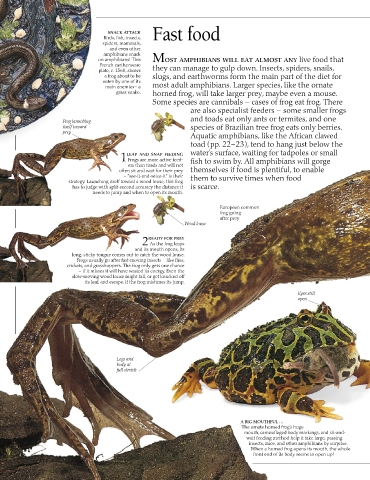
                                           LEAP  AND  SNAP  FEEDING  water’s surface, waiting for tadpoles or small
                                         1 Frogs are more active feed-  fish to swim by. All amphibians will gorge
                                           ers than toads and will not
                                        often sit and wait for their prey   themselves if food is plentiful, to enable
                                          – “see-it-and-seize-it” is their   them to survive times when food
                        strategy. Launching itself toward a wood louse, this frog
                         has to judge with split-second accuracy the distance it   is scarce.
                                needs to jump and when to open its mouth.

                                                                          European common
                                                                          frog going
                                                                          after prey
                                                              Wood louse

                                                  READY FOR PREY
                                                2 As the frog leaps
                                              and its mouth opens, its
                         long, sticky tongue comes out to catch the wood louse.
                          Frogs usually go after fast-moving insects – like flies,
                       crickets, and grasshoppers. The frog only gets one chance
                           – if it misses it will have wasted its energy. Even the
                         slow-moving wood louse might fall, or get knocked off
                             its leaf, and escape, if the frog mistimes its jump.
                                                                                                    Eyes still
                                                                                                    open


                                        Legs and
                                        body at
                                        full stretch


                                                                                 A BIG MOUTHFUL …
                                                                                 The ornate horned frog’s huge
                                                                                  mouth, camouflaged body markings, and sit-and-
                                                                                   wait feeding method help it take large, passing
                                                                                   insects, mice, and other amphibians by surprise.
                                                                                    When a horned frog opens its mouth, the whole
                                                                                     front end of its body seems to open up!

