


Page 148 - (DK) Home Doctor: Providing practical advice on home treatments
P. 148
146 COMMON CONDITIONS: PROBLEMS IN BABIES

         Sleep problems (babies)


              In the first 3 months of a baby’s life, night waking is to be expected because all babies need to be fed at night.
              Some continue to need night feedings for up to 6 months. Sleep problems in these early months tend to center
              on getting a baby to settle again after a feeding, particularly at night, or the baby waking again after a short
              time. Older babies who are difficult to put to bed and/or who wake at intervals during the night need a fixed
              bedtime routine and, sometimes, a period of training in how to fall asleep by themselves and resettle themselves
              when they wake. Illness, changes in routine, and feeding problems can all affect a baby’s sleep temporarily.
              See also Feeding problems, pp.144–145; Colic, p.148; Excessive crying, p.149.


              See your doctor first
                                                                    PRACTICAL TIPS
              Arrange to see your doctor if:
                                                            Establishing sleep associations
              ● Your baby seems unwell or you are
                                                            Using the same sequence of events every night will
              concerned about him or her in any way         help your baby associate them with falling asleep.
              ● Your baby wakes up suddenly screaming
              and cannot be consoled                        ● Bathe your baby at the same time each evening
                                                            and make this a calm, quiet time, if possible, without
                                                            too much stimulation and excitement.
                                                            ● For a baby under 6 months, place the baby on his
         What you can do yourself                           or her back in an airy crib. Stay beside the crib with
                                                            your hand resting lightly on his or her chest and sing.
              Try some or all of the following measures if your
                                                            Stick to the same song every night since this will
              baby does not sleep well. Sticking to a routine with
                                                            now become your baby’s sleep association.
              your baby and being consistent in your approach  ● For older babies, sit by the crib spending time with
              will bring results, although it may take time.  your baby with a book or favorite toy and then settle
                                                            your baby. Over time, a favorite soft toy, muslin
              Babies up to 4 months                         cloth, or blanket may become a transitional object
              ● Keep a sleep journal for a week, noting when
                                                            that helps a baby to sleep. Some babies find their
              and how your baby falls asleep and wakes. This  own thumb and suck it for comfort.
              will show whether there is a pattern to sleep
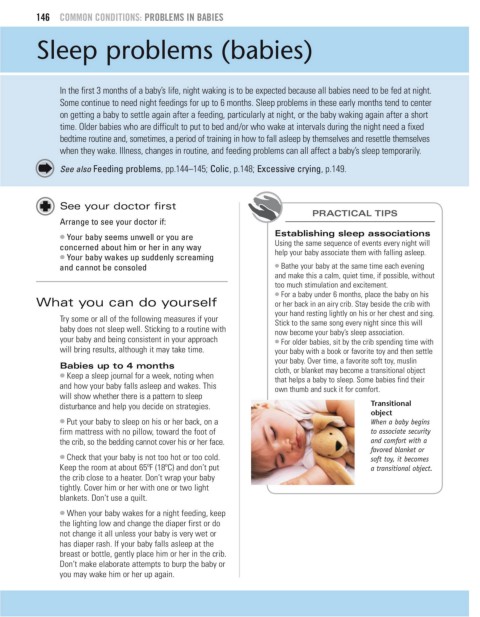
              disturbance and help you decide on strategies.                     Transitional
                                                                                 object
              ● Put your baby to sleep on his or her back, on a                  When a baby begins
              firm mattress with no pillow, toward the foot of                   to associate security
              the crib, so the bedding cannot cover his or her face.             and comfort with a
                                                                                 favored blanket or
              ● Check that your baby is not too hot or too cold.                 soft toy, it becomes
              Keep the room at about 65ºF (18ºC) and don’t put                   a transitional object.
              the crib close to a heater. Don’t wrap your baby
              tightly. Cover him or her with one or two light
              blankets. Don’t use a quilt.
              ● When your baby wakes for a night feeding, keep
              the lighting low and change the diaper first or do
              not change it all unless your baby is very wet or
              has diaper rash. If your baby falls asleep at the
              breast or bottle, gently place him or her in the crib.
              Don’t make elaborate attempts to burp the baby or
              you may wake him or her up again.

