


Page 150 - (DK) Home Doctor: Providing practical advice on home treatments
P. 150
148 COMMON CONDITIONS: PROBLEMS IN BABIES

         Colic


              Colic is used to describe bouts of crying and upset behavior in an otherwise healthy baby. These bouts tend
              to recur at the same time each day, usually in the early evening, and can last for 3 hours or more. A colicky
              baby screams and draws up his or her knees, clenches the fists, and appears to have a stomachache.
              Comforting has little effect. As many as 1 in 5 babies develops colic, usually starting 2–3 weeks after birth,
              and no one is sure why it occurs. The problem disappears when the baby is about 4 months old and causes
              no lasting harm, but it is distressing for parents. In a few babies, colic may be due to a cows’ milk allergy.
              See also Feeding problems, pp.144–145; Sleep problems, pp.146–147; Excessive crying, opposite page.


              See your doctor first
                                                                    PRACTICAL TIPS
              Make an appointment to see your doctor if:
              ● Your baby’s behavior or crying suddenly     Calming a colicky baby A colicky
                                                            baby can be unpredictable so you might need to
              changes from its normal pattern               switch tactics from time to time.
              ● Your baby has a fever, diarrhea, or vomiting
              ● There is blood in your baby’s feces         ● If your baby is jumpy and oversensitive to
              ● Your baby is not gaining enough weight      stimulation, try a tranquil, orderly bedtime routine,
                                                            taking time to bathe and feed your baby. Put him or
                                                            her in a crib in a quiet place, with the lights dimmed.
                                                            ● Background noise calms some babies, so try putting
         What you can do yourself                           your baby to sleep with a vacuum cleaner or washing
                                                            machine running nearby. If your baby can only be
              Colic varies from one baby to the next, so try a  calmed by movement, try an outing in the carriage or
              variety of measures to see which helps.       put him or her in a car seat and go for a drive.
                                                                        ● Enlist help from family and
              ● If you are bottle-feeding, try changing to a
                                                                          friends during difficult
              hypoallergenic formula for a week to see if
                                                                            evenings. If you are on your
              the problem is due to a milk allergy. If you are
                                                                            own, put the baby in a sling
              breast-feeding, exclude dairy products from your
                                                                                and sing to him or her
              diet. If colic improves, continue these measures.                     while you do
              ● Too much caffeine in breast milk can make a                          other tasks.
              breast-fed baby irritable, so reduce your intake
              of coffee and other caffeinated drinks.
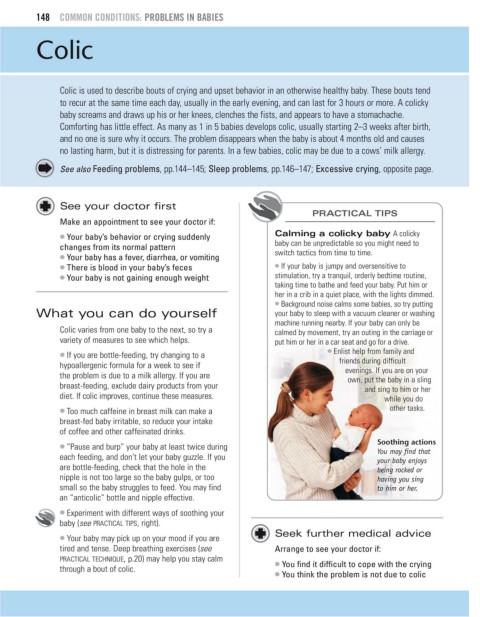
                                                                                  Soothing actions
              ● “Pause and burp” your baby at least twice during
                                                                                  You may find that
              each feeding, and don’t let your baby guzzle. If you
                                                                                  your baby enjoys
              are bottle-feeding, check that the hole in the                      being rocked or
              nipple is not too large so the baby gulps, or too                   having you sing
              small so the baby struggles to feed. You may find                   to him or her.
              an “anticolic” bottle and nipple effective.
              ● Experiment with different ways of soothing your
              baby (see PRACTICAL TIPS, right).
                                                            Seek further medical advice
              ● Your baby may pick up on your mood if you are
              tired and tense. Deep breathing exercises (see  Arrange to see your doctor if:
              PRACTICAL TECHNIQUE, p.20) may help you stay calm
                                                            ● You find it difficult to cope with the crying
              through a bout of colic.
                                                            ● You think the problem is not due to colic

