


Page 151 - (DK) Home Doctor: Providing practical advice on home treatments
P. 151
COMMON CONDITIONS: PROBLEMS IN BABIES  149

         Excessive crying


              Crying is the way a baby communicates its needs, and most young babies cry intermittently for up to 3 hours
              a day. The usual causes are hunger, discomfort from a wet or dirty diaper, gas, loneliness, being too hot or
              too cold, or being overtired. As parents learn to recognize types of crying and respond quickly, the baby tends
              to cry less. However, if you have a baby who cries excessively, he or she will sleep much less than the
              16–18 hours that is normal for a newborn baby. Your baby may be difficult to feed, soothe, and settle, and
              leave you feeling inadequate and exhausted. Most babies grow out of excessive crying by the age of 6 months.
              See also Feeding problems, pp.144–145; Sleep problems, pp.146–147; Colic, opposite page.


              See your doctor first
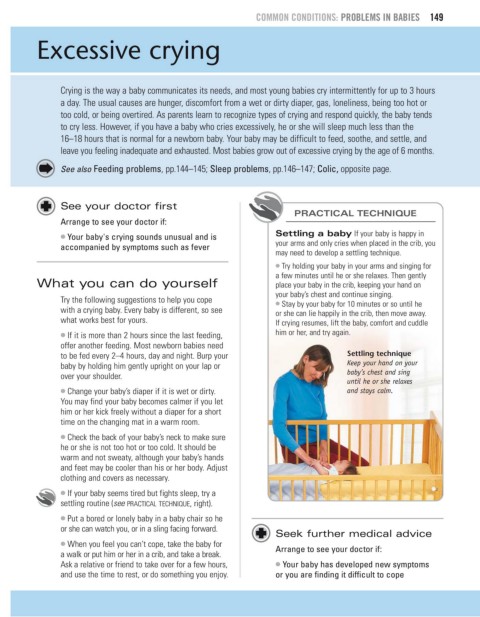
                                                                 PRACTICAL TECHNIQUE
              Arrange to see your doctor if:
              ● Your baby's crying sounds unusual and is    Settling a baby If your baby is happy in
                                                            your arms and only cries when placed in the crib, you
              accompanied by symptoms such as fever
                                                            may need to develop a settling technique.
                                                            ● Try holding your baby in your arms and singing for
                                                            a few minutes until he or she relaxes. Then gently
         What you can do yourself                           place your baby in the crib, keeping your hand on
                                                            your baby’s chest and continue singing.
              Try the following suggestions to help you cope
                                                            ● Stay by your baby for 10 minutes or so until he
              with a crying baby. Every baby is different, so see  or she can lie happily in the crib, then move away.
              what works best for yours.                    If crying resumes, lift the baby, comfort and cuddle
              ● If it is more than 2 hours since the last feeding,  him or her, and try again.
              offer another feeding. Most newborn babies need
              to be fed every 2–4 hours, day and night. Burp your           Settling technique
              baby by holding him gently upright on your lap or             Keep your hand on your
                                                                            baby’s chest and sing
              over your shoulder.
                                                                            until he or she relaxes
              ● Change your baby’s diaper if it is wet or dirty.            and stays calm.
              You may find your baby becomes calmer if you let
              him or her kick freely without a diaper for a short
              time on the changing mat in a warm room.
              ● Check the back of your baby’s neck to make sure
              he or she is not too hot or too cold. It should be
              warm and not sweaty, although your baby’s hands
              and feet may be cooler than his or her body. Adjust
              clothing and covers as necessary.
              ● If your baby seems tired but fights sleep, try a
              settling routine (see PRACTICAL TECHNIQUE, right).
              ● Put a bored or lonely baby in a baby chair so he
              or she can watch you, or in a sling facing forward.
                                                            Seek further medical advice
              ● When you feel you can’t cope, take the baby for
                                                            Arrange to see your doctor if:
              a walk or put him or her in a crib, and take a break.
              Ask a relative or friend to take over for a few hours,  ● Your baby has developed new symptoms
              and use the time to rest, or do something you enjoy.  or you are finding it difficult to cope

