


Page 147 - (DK) Home Doctor: Providing practical advice on home treatments
P. 147
COMMON CONDITIONS: PROBLEMS IN BABIES  145


         What you can do yourself continued…
                                                                     PRACTICAL TIPS
              ● A baby who has been diagnosed with reflux
              needs a special feeding regimen until he or she grows  Coping with reflux A baby with reflux
              out of the condition (see PRACTICAL TIPS, right).  will dislike being laid flat on his or her back and
                                                            needs to be handled carefully after a feeding. The
              Breast-feeding                                following measures will help reduce regurgitation.
              ● If you have not breast-fed before, there are
              several tips that will help get you off to a good  ● Change your baby’s diaper before the feeding and
              start (see PRACTICAL TECHNIQUE, left). Make sure  handle your baby gently and hold him or her upright
              you have help from someone who has had        after the feeding.
                                                            ● Give smaller feedings more frequently to avoid
              experience in breast-feeding.
                                                            overloading your baby’s stomach.
              ● Your baby may find it hard to latch on if your  ● If you are bottle-feeding, use a thickened formula,
              breasts are engorged or very full. Expressing a  designed for babies with reflux problems. (Ask your
              little milk before he or she begins to feed will  doctor for advice.) Don’t add extra powdered formula
              soften the breast. This will also help if your baby  to a feeding. A breast-fed baby over 4 months old
                                                            can be given 2 teaspoonfuls (10 ml) of baby rice
              chokes because your milk flows too fast.
                                                            cereal dissolved in 2 tablespoons (30 ml) of
              ● Until your baby has learned to breast-feed  expressed milk or formula before feedings.
              properly, don’t use pacifiers or bottles.     ● Your baby may be more comfortable in a baby seat
                                                            immediately after a feeding. Raising the head of the
              ● Occasionally expressing milk by hand or using
                                                            crib slightly on books or bricks may help make your
              a breast pump between feedings will help empty  baby more comfortable during sleep.
              the breast and stimulate a good supply of milk.
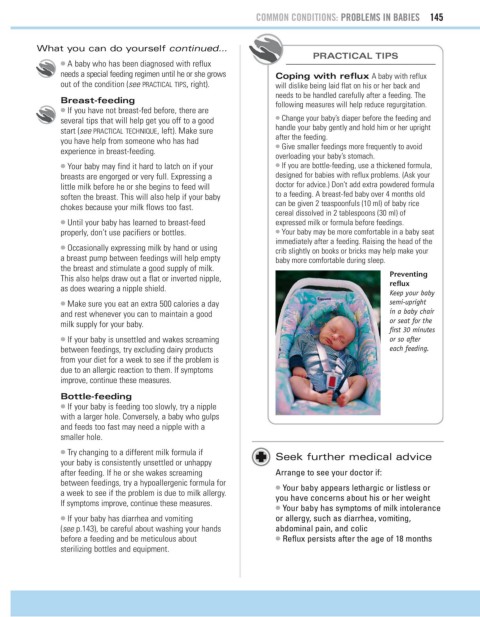
                                                                                     Preventing
              This also helps draw out a flat or inverted nipple,
                                                                                     reflux
              as does wearing a nipple shield.
                                                                                     Keep your baby
              ● Make sure you eat an extra 500 calories a day                        semi-upright
              and rest whenever you can to maintain a good                           in a baby chair
              milk supply for your baby.                                             or seat for the
                                                                                     first 30 minutes
              ● If your baby is unsettled and wakes screaming                        or so after
              between feedings, try excluding dairy products                         each feeding.
              from your diet for a week to see if the problem is
              due to an allergic reaction to them. If symptoms
              improve, continue these measures.
              Bottle-feeding
              ● If your baby is feeding too slowly, try a nipple
              with a larger hole. Conversely, a baby who gulps
              and feeds too fast may need a nipple with a
              smaller hole.

              ● Try changing to a different milk formula if
                                                            Seek further medical advice
              your baby is consistently unsettled or unhappy
              after feeding. If he or she wakes screaming   Arrange to see your doctor if:
              between feedings, try a hypoallergenic formula for
                                                            ● Your baby appears lethargic or listless or
              a week to see if the problem is due to milk allergy.
                                                            you have concerns about his or her weight
              If symptoms improve, continue these measures.
                                                            ● Your baby has symptoms of milk intolerance
              ● If your baby has diarrhea and vomiting      or allergy, such as diarrhea, vomiting,
              (see p.143), be careful about washing your hands  abdominal pain, and colic
              before a feeding and be meticulous about      ● Reflux persists after the age of 18 months
              sterilizing bottles and equipment.

