


Page 30 - (DK Eyewitness) Travel Guide - London
P. 30
28 INTRODUCING L ONDON
Georgian London
The foundation of the Bank of England in 1694 spurred
the growth of London and, by the time George I came to the
throne in 1714, it had become an important financial and
commercial centre. Aristocrats with West End estates began
laying out elegant squares and terraces to house newly rich
merchants. Architects such as the Adam brothers, John Soane
and John Nash developed stylish medium-scale housing. Extent of the City
They drew inspiration from the great European capitals, as 1810 Today
did English painters, sculptors, composers and craftsmen.
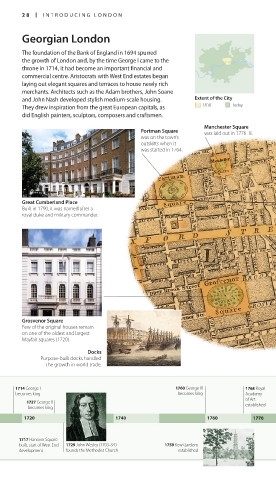
Manchester Square
Portman Square was laid out in 1776–8.
was on the town’s
outskirts when it
was started in 1764.
Great Cumberland Place
Built in 1790, it was named after a
royal duke and military commander.
Grosvenor Square
Few of the original houses remain
on one of the oldest and largest
Mayfair squares (1720).
Docks
Purpose-built docks handled
the growth in world trade.
1714 George I 1760 George III 1768 Royal
becomes king becomes king Academy
of Art
1727 George II
becomes king established
1720 1740 1760 1770
1717 Hanover Square
built, start of West End 1729 John Wesley (1703–91) 1759 Kew Gardens
development founds the Methodist Church established
028-029_EW_London.indd 28 21/03/17 2:19 pm

