


Page 24 - Dinosaur (DK Eyewitness Books)
P. 24
Little and large


                                       SȢȺ qȥȪȯȰȴȢȶȳr Ȣȯȥ ȮȰȴȵ ȱȦȰȱȭȦ picture a beast as tall as a house. In
                                       fact, most dinosaurs were no bigger than an elephant and weighed less.
                                       But some sauropods were the longest and most massive animals ever to
                                       walk on land. Built a bit like a giant giraffe, Brachiosaurus stood as high
                                       as a four-story building. Diplodocus measured up to 110 ft (33.5 m)—as
                                       long as a row of three buses. Both dinosaurs lived in North America.
                                       South America’s Argentinosaurus was as long as Diplodocus, but bulkier—
                                       almost as heavy as 10 bull elephants. Perhaps the largest of all dinosaurs
                                       was North America’s Amphicoelias. Sadly, scientists found only part of one
                                       of its vertebrae (backbones), then lost it. Any of these giants could have
                                       stepped on the tiniest theropods and not even noticed. The theropod
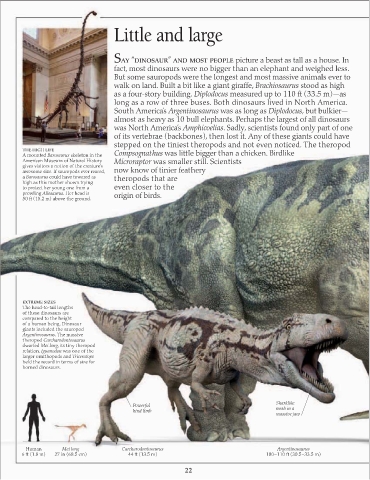
        THE HIGH LIFE
        A mounted Barosaurus skeleton in the   Compsognathus was little bigger than a chicken. Birdlike
        American Museum of Natural History   Microraptor was smaller still. Scientists
        gives visitors a notion of the creature’s
        awesome size. If sauropods ever reared,   now know of tinier feathery
        a Barosaurus could have towered as   theropods that are
        high as this mother shown trying
        to protect her young one from a   even closer to the
        prowling Allosaurus. Her head is   origin of birds.
        50 ft (15.2 m) above the ground.


        EXTREME SIZES
        The head-to-tail lengths
        of these dinosaurs are
        compared to the height
        of a human being. Dinosaur
        giants included the sauropod
        Argentinosaurus. The massive
        theropod Carcharodontosaurus
        dwarfed Mei long, its tiny theropod
        relation. Iguanodon was one of the
        larger ornithopods and Triceratops
        held the record in terms of size for
        horned dinosaurs.


                                                                                            Sharklike
                                             Powerful
                                                                                            teeth in a
                                             hind limb
                                                                                            massive jaw


          Human       Mei long           Carcharodontosaurus                                 Argentinosaurus
        6 ft (1.8 m)  27 in (68.5 cm)      44 ft (13.5 m)                                100–110 ft (30.5–33.5 m)

                                                              22

