


Page 23 - Dinosaur (DK Eyewitness Books)
P. 23
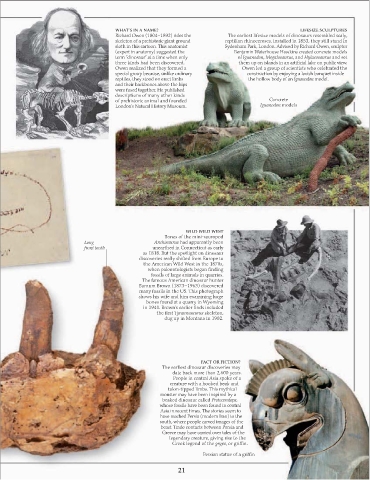
WHAT’S IN A NAME?                                            LIFESIZE SCULPTURES
                                       Richard Owen (1804–1892) rides the   The earliest lifesize models of dinosaurs resembled scaly,
                                       skeleton of a prehistoric giant ground   reptilian rhinoceroses. Installed in 1853, they still stand in
                                       sloth in this cartoon. This anatomist   Sydenham Park, London. Advised by Richard Owen, sculptor
                                       (expert in anatomy) suggested the      Benjamin Waterhouse Hawkins created concrete models
                                       term “dinosaur” at a time when only      of Iguanodon, Megalosaurus, and Hylaeosaurus and set
                                       three kinds had been discovered.         them up on islands in an artificial lake on public view.
                                       Owen realized that they formed a          Owen led a group of scientists who celebrated the
                                       special group because, unlike ordinary      construction by enjoying a lavish banquet inside
                                       reptiles, they stood on erect limbs         the hollow body of an Iguanodon model.
                                       and their backbones above the hips
                                       were fused together. He published
                                       descriptions of many other kinds
                                       of prehistoric animal and founded                  Concrete
                                       London’s Natural History Museum.                Iguanodon models


                                                               WILD WILD WEST
                                                       Bones of the mini-sauropod
                             Long                   Anchisaurus had apparently been
                             front tooth           unearthed in Connecticut as early
                                                as 1818. But the spotlight on dinosaur
                                               discoveries really shifted from Europe to
                                                the American Wild West in the 1870s,
                                                  when paleontologists began finding
                                                   fossils of large animals in quarries.
                                                The famous American dinosaur hunter
                                               Barnum Brown (1873–1963) discovered
                                               many fossils in the US. This photograph
                                               shows his wife and him examining huge
                                                 bones found at a quarry in Wyoming
                                                in 1941. Brown’s earlier finds included
                                                     the first Tyrannosaurus skeleton,
                                                       dug up in Montana in 1902.


                                                                    FACT OR FICTION?
                                                       The earliest dinosaur discoveries may
                                                          date back more than 2,600 years.
                                                          People in central Asia spoke of a
                                                         creature with a hooked beak and
                                                         talon-tipped limbs. This mythical
                                                      monster may have been inspired by a
                                                       beaked dinosaur called Protoceratops,
                                                      whose fossils have been found in central
                                                      Asia in recent times. The stories seem to
                                                      have reached Persia (modern Iran) to the
                                                      south, where people carved images of the
                                                      beast. Trade contacts between Persia and
                                                       Greece may have carried over tales of the
                                                         legendary creature, giving rise to the
                                                          Greek legend of the gryps, or griffin.
                                                                    Persian statue of a griffin

                                                            21

