


Page 36 - Dinosaur (DK Eyewitness Books)
P. 36
Plant-eaters


                                          TȩȦ ȫȢȸȴ  ȵȦȦȵȩ  ȴȵȰȮȢȤȩ  Ȣȯȥ Ȩȶȵ of herbivorous (plant-eating)
                                          dinosaurs were made for cropping, chewing, and digesting
                                          vegetation. Broad-snouted armored dinosaurs were unfussy eaters,
                                   Square
                                   jaw    while armored dinosaurs with a narrow snout picked out just the
                                          plants they liked. Sauropods stripped twigs with teeth shaped like
                                          spoons or pencils, then swallowed leafy mouthfuls whole. The beaks
                                          of horned dinosaurs sliced through tough, fibrous vegetation that
                                          their sharp cheek teeth chewed into pulp. Hadrosaurs (duck-billed
                                          dinosaurs) cropped leaves with their toothless beaks and chewed
                                          them with batteries of cheek teeth. Most ornithischians probably
                                          had fleshy cheeks to hold food while chewing. All of these herbivores
                                          had long intestines to digest large amounts of plant food.


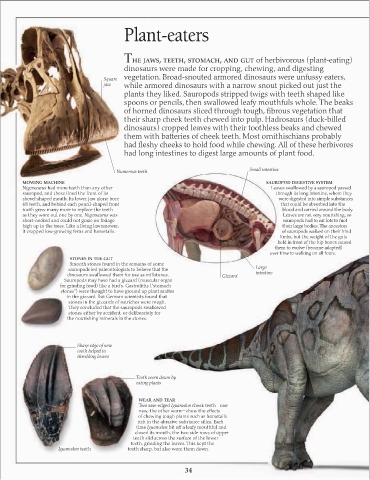
                                                                                    Small intestine
                                        Numerous teeth
        MOWING MACHINE                                                                   SAUROPOD DIGESTIVE SYSTEM
        Nigersaurus had more teeth than any other                                          Leaves swallowed by a sauropod passed
        sauropod, and these lined the front of its                                          through its long intestine, where they
        shovel-shaped mouth. Its lower jaw alone bore                                        were digested into simple substances
        68 teeth, and behind each pencil-shaped front                                         that could be absorbed into the
        tooth grew many more to replace the teeth                                             blood and carried around the body.
        as they wore out one by one. Nigersaurus was                                           Leaves are not very nourishing, so
        short-necked and could not graze on foliage                                            sauropods had to eat lots to fuel
        high up in the trees. Like a living lawnmower,                                        their large bodies. The ancestors
        it cropped low-growing ferns and horsetails.                                          of sauropods walked on their hind
                                                                                              limbs, but the weight of the guts
                                                                                             held in front of the hip bones caused
                                                                                            them to evolve (become adapted)
                                                                                          over time to walking on all fours.
                        STONES IN THE GUT
                        Smooth stones found in the remains of some
                        sauropods led paleontologists to believe that the             Large
                       dinosaurs swallowed them for use as millstones.     Gizzard    intestine
                      Sauropods may have had a gizzard (muscular organ
                     for grinding food) like a bird’s. Gastroliths (“stomach
                     stones”) were thought to have ground up plant matter
                       in the gizzard. But German scientists found that
                        stones in the gizzards of ostriches were rough.
                        They concluded that the sauropods swallowed
                        stones either by accident, or deliberately for
                       the nourishing minerals in the stones.


                           Sharp edge of new
                           tooth helped in
                           shredding leaves


                                              Tooth worn down by
                                              eating plants

                                               WEAR AND TEAR
                                               Two saw-edged Iguanodon cheek teeth—one
                                               new, the other worn—show the effects
                                               of chewing tough plants such as horsetails
                                               rich in the abrasive substance silica. Each
                                              time Iguanodon bit off a leafy mouthful and
                                              closed its mouth, the two side rows of upper
                                             teeth slid across the surface of the lower
                                            teeth, grinding the leaves. This kept the
                    Iguanodon teeth        teeth sharp, but also wore them down.


                                                              34

