


Page 32 - Dinosaur (DK Eyewitness Books)
P. 32
Senses and communication


        Long, tubelike crest
        made of nose bones
                                                DȪȯȰȴȢȶȳȴ ȥȦȱȦȯȥȦȥ Ȱȯ sight, smell, taste,
                                                hearing, balance, and touch to tell them
        CALLING OUT
        Parasaurolophus tooted                  how to find food and mates, and to
        like a trombone by forcing air        detect danger. Because organs like eyes
        out through its hollow head crest.
        Other members of its herd standing   and nostrils seldom fossilize, anatomists
        some distance away could hear and   (experts in anatomy) cannot examine a
        respond—like other hadrosaurs,
        Parasaurolophus had a good sense of   dinosaur’s sense organs directly to judge
        hearing. Hadrosaurs without head   how well they worked. But there are clues
        crests probably called by blowing
        up skin flaps on their faces, much    in parts of a dinosaur’s skull. For instance,
        as frogs can produce loud croaks    holes for the eyes help to tell us their size
        by inflating their throat pouches.
                                       and the way they faced, and the shape of
                                       a braincase in a skull may show that the
                                       brain it contained had large, complex
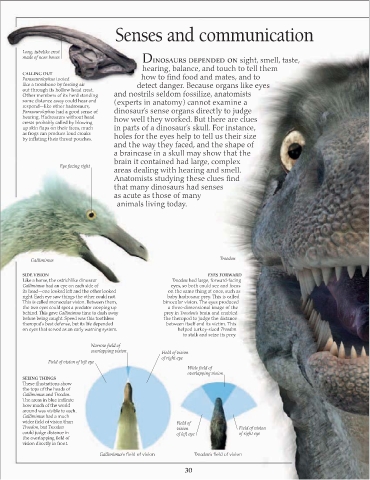
                     Eye facing right
                                       areas dealing with hearing and smell.
                                       Anatomists studying these clues find
                                       that many dinosaurs had senses
                                       as acute as those of many
                                        animals living today.


           Gallimimus                                                     Troodon

        SIDE VISION                                                   EYES FORWARD
        Like a horse, the ostrichlike dinosaur            Troodon had large, forward-facing
        Gallimimus had an eye on each side of             eyes, so both could see and focus
        its head—one looked left and the other looked    on the same thing at once, such as
        right. Each eye saw things the other could not.   baby hadrosaur prey. This is called
        This is called monocular vision. Between them,   binocular vision. The eyes produced
        the two eyes could spot a predator creeping up   a three-dimensional image of the
        behind. This gave Gallimimus time to dash away   prey in Troodon’s brain and enabled
        before being caught. Speed was this toothless   the theropod to judge the distance
        theropod’s best defense, but its life depended    between itself and its victim. This
        on eyes that served as an early warning system.     helped turkey-sized Troodon
                                                              to stalk and seize its prey.
                               Narrow field of
                               overlapping vision      Field of vision
                                                       of right eye
                 Field of vision of left eye
                                                               Wide field of
                                                               overlapping vision
        SEEING THINGS
        These illustrations show
        the tops of the heads of
        Gallimimus and Troodon.
        The areas in blue indicate
        how much of the world
        around was visible to each.
        Gallimimus had a much
        wider field of vision than                         Field of
        Troodon, but Troodon                               vision               Field of vision
        could judge distance in                            of left eye          of right eye
        the overlapping field of
        vision directly in front.
                                  Gallimimus’s field of vision   Troodon’s field of vision

                                                              30

