


Page 39 - Dinosaur (DK Eyewitness Books)
P. 39
Hollowed-out      Neural spine
                                                                                   areas lightened   (ridge rising
                                                                                   the neck bones    from vertebra)


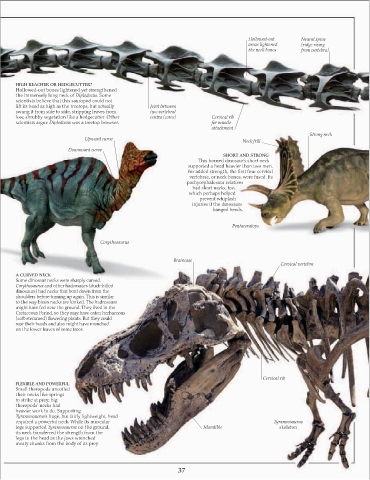
      HIGH REACHER OR HEDGECUTTER?
      Hollowed-out bones lightened yet strengthened
      the immensely long neck of Diplodocus. Some
      scientists believe that this sauropod could not
      lift its head as high as the treetops, but actually   Joint between
      swung it from side to side, stripping leaves from   two vertebral
      low, shrubby vegetation like a hedgecutter. Other   centra (cores)  Cervical rib
      scientists argue Diplodocus was a treetop browser.               for muscle
                                                                       attachment
                                                                                                        Strong neck
                             Upward curve
                                                                                 Neck frill
                        Downward curve
                                                                           SHORT AND STRONG
                                                                   This horned dinosaur’s short neck
                                                               supported a head heavier than two men.
                                                               For added strength, the first four cervical
                                                                vertebrae, or neck bones, were fused. Its
                                                               pachycephalosaur relatives
                                                                 had short necks, too,
                                                                which perhaps helped
                                                                   prevent whiplash
                                                                 injuries if the dinosaurs
                                                                       banged heads.

                                                                              Pentaceratops


                                  Corythosaurus

                                                          Braincase
                                                                                              Cervical vertebra
      A CURVED NECK
      Some dinosaur necks were sharply curved.
      Corythosaurus and other hadrosaurs (duck-billed
      dinosaurs) had necks that bent down from the
      shoulders before turning up again. This is similar
      to the way bison necks are kinked. The hadrosaurs
      might have fed near the ground. They lived in the
      Cretaceous Period, so they may have eaten herbaceous
      (soft-stemmed) flowering plants. But they could
      rear their heads and also might have munched
      on the lower leaves of some trees.


                                                                                        Cervical rib
      FLEXIBLE AND POWERFUL
      Small theropods uncoiled
      their necks like springs
      to strike at prey; big
      theropods’ necks had
      heavier work to do. Supporting
      Tyrannosaurus’s huge, but fairly lightweight, head
      required a powerful neck. While its muscular                                          Tyrannosaurus
      legs supported Tyrannosaurus on the ground,                   Mandible                 skeleton
      its neck transferred the strength from the
      legs to the head as the jaws wrenched
      meaty chunks from the body of its prey.


                                                            37

