


Page 34 - Dinosaur (DK Eyewitness Books)
P. 34
Meat-eaters                                                   Serrated edge
                                                                  Cracks due
                                                                  to fossilization
                                                                                                    New tooth
        MȢȯȺ ȭȢȳȨȦ ȮȦȢȵ ȦȢȵȪȯȨ ȥȪȯȰȴȢȶȳȴ had jaws
         used as weapons for killing and tearing up big game.
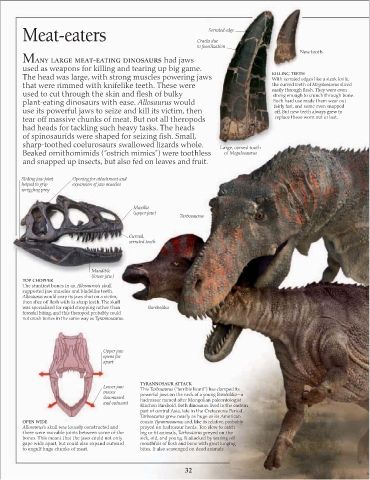
                                                                                           KILLING TEETH
         The head was large, with strong muscles powering jaws                             With serrated edges like a steak knife,
         that were rimmed with knifelike teeth. These were                                 the curved teeth of Megalosaurus sliced
                                                                                           easily through flesh. They were even
         used to cut through the skin and flesh of bulky                                   strong enough to crunch through bone.
         plant-eating dinosaurs with ease. Allosaurus would                                Such hard use made them wear out
                                                                                            fairly fast, and some even snapped
        use its powerful jaws to seize and kill its victim, then                            off. But new teeth always grew to
        tear off massive chunks of meat. But not all theropods                              replace those worn out or lost.
        had heads for tackling such heavy tasks. The heads
        of spinosaurids were shaped for seizing fish. Small,
        sharp-toothed coelurosaurs swallowed lizards whole.               Large, curved tooth
        Beaked ornithomimids (“ostrich mimics”) were toothless             of Megalosaurus
        and snapped up insects, but also fed on leaves and fruit.

        Sliding jaw joint   Opening for attachment and
        helped to grip   expansion of jaw muscles
        wriggling prey

                                             Maxilla
                                             (upper jaw)
                                                            Tarbosaurus

                                            Curved,
                                            serrated tooth


                               Mandible
                               (lower jaw)
        TOP CHOPPER
        The sturdiest bones in an Allosaurus’s skull
        supported jaw muscles and bladelike teeth.
        Allosaurus would snap its jaws shut on a victim,
        then slice off flesh with its sharp teeth. The skull
        was specialized for rapid chopping rather than   Barsboldia
        forceful biting, and this theropod probably could
        not crush bones in the same way as Tyrannosaurus.


                                   Upper jaw
                                   opens far
                                   apart


                                               TYRANNOSAUR ATTACK
                                   Lower jaw   This Tarbosaurus (“terrible lizard”) has clamped its
                                   moves
                                               powerful jaws on the neck of a young Barsboldia—a
                                   downward
                                               hadrosaur named after Mongolian paleontologist
                                   and outward
                                               Rinchen Barsbold. Both dinosaurs lived in the eastern
                                               part of central Asia, late in the Cretaceous Period.
                                               Tarbosaurus grew nearly as huge as its American
        OPEN WIDE                              cousin Tyrannosaurus, and, like its relative, probably
        Allosaurus’s skull was loosely constructed and   preyed on hadrosaur herds. Too slow to catch
        there were movable joints between some of the   big or fit animals, Tarbosaurus preyed on the
        bones. This meant that the jaws could not only   sick, old, and young. It attacked by tearing off
        gape wide apart, but could also expand outward   mouthfuls of flesh and bone with great lunging
        to engulf huge chunks of meat.         bites. It also scavenged on dead animals.
                                                              32

