


Page 38 - Dinosaur (DK Eyewitness Books)
P. 38
Long and short necks

                                                                                                  Cervical vertebra
                                                                                                  (neck bone)
        SȢȶȳȰȱȰȥȴ ȩȢȥ ȵȩȦ ȭȰȯȨȦȴȵ ȯȦȤȬȴ of all dinosaurs—some more
         than five times as long as a giraffe’s. Prosauropods and sauropods
         were the first animals that could graze on treetop leaves while
         standing on the ground. In contrast, most armored, plated, and
         horned dinosaurs had short, strong necks, and generally fed
         on vegetation near the ground. The length of a plant-eating
         dinosaur’s neck determined which levels of vegetation it
         could browse. Theropods had a muscular S-shaped neck, like
         a bird’s. Large meat-eaters, such as Tyrannosaurus, had massive                           Mandible
                                                                                                   (lower jaw)
        necks, while smaller theropods, such as Velociraptor, had slim necks
         that uncoiled like springs when attacking prey.


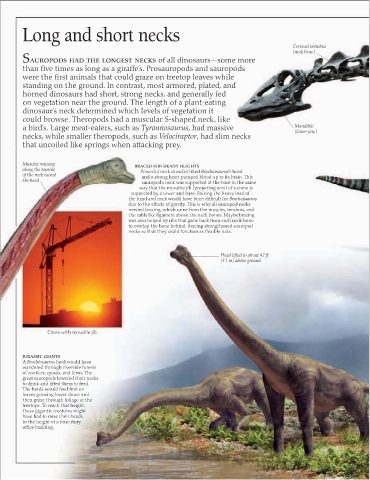
        Muscles running                       BRACED FOR HEADY HEIGHTS
        along the topside                       Powerful neck muscles lifted Brachiosaurus’s head
        of the neck raised                      and a strong heart pumped blood up to its brain. This
        the head
                                                sauropod’s neck was supported at the base in the same
                                               way that the movable jib (projecting arm) of a crane is
                                            supported by a tower and base. Raising the heavy load of
                                            the head and neck would have been difficult for Brachiosaurus
                                            due to the effects of gravity. This is why all sauropod necks
                                            needed bracing, which came from the muscles, tendons, and
                                            the cablelike ligament above the neck bones. Maybe bracing
                                            was also helped by ribs that grew back from each neck bone
                                            to overlap the bone behind. Bracing strengthened sauropod
                                            necks so that they could function as flexible rods.


                                                                          Head lifted to about 42 ft
                                                                          (13 m) above ground


                 Crane with movable jib


        JURASSIC GIANTS
        A Brachiosaurus herd would have
        wandered through riverside forests
        of conifers, cycads, and ferns. The
        great sauropods lowered their necks
        to drink and lifted them to feed.
        The herds would feed first on
        leaves growing lower down and
        then graze through foliage at the
        treetops. To reach that height,
        these gigantic creatures might
        have had to raise their heads
        to the height of a four-story
        office building.

