


Page 37 - Dinosaur (DK Eyewitness Books)
P. 37
Long neck helped in
                     reaching leaves on treetops


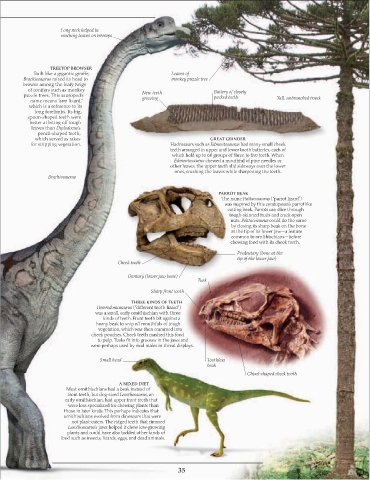
                  TREETOP BROWSER
            Built like a gigantic giraffe,                Leaves of
         Brachiosaurus raised its head to                 monkey puzzle tree
         browse among the leafy twigs
          of conifers such as monkey            New teeth               Battery of closely
         puzzle trees. This sauropod’s          growing                 packed teeth         Tall, unbranched trunk
           name means “arm lizard,”
           which is a reference to its
             long forelimbs. Its big,
          spoon-shaped teeth were
           better at biting off tough
           leaves than Diplodocus’s
              pencil-shaped teeth,
             which served as rakes                                     GREAT GRINDER
           for stripping vegetation.                     Hadrosaurs such as Edmontosaurus had many small cheek
                                                         teeth arranged in upper and lower tooth batteries, each of
                                                          which held up to 60 groups of three to five teeth. When
                                                           Edmontosaurus chewed a mouthful of pine needles or
                                                         other leaves, the upper teeth slid sideways over the lower
                                                           ones, crushing the leaves while sharpening the teeth.
                 Brachiosaurus


                                                                         PARROT BEAK
                                                                          The name Psittacosaurus (“parrot lizard”)
                                                                           was inspired by this ceratopsian’s parrotlike
                                                                            cutting beak. Parrots can slice through
                                                                             tough-skinned fruits and crack open
                                                                             nuts. Psittacosaurus could do the same
                                                                              by closing its sharp beak on the bone
                                                                              at the tip of its lower jaw—a feature
                                                                              common to ornithischians—before
                                                                             chewing food with its cheek teeth.
                                                                                Predentary (bone at the
                                                                                tip of the lower jaw)
                                        Cheek tooth

                                           Dentary (lower jaw bone)
                                                                  Tusk
                                                   Sharp front tooth
                                            THREE KINDS OF TEETH
                                 Heterodontosaurus (“different tooth lizard”)
                                 was a small, early ornithischian with three
                                   kinds of teeth. Front teeth bit against a
                                 horny beak to snip off mouthfuls of tough
                                  vegetation, which was then crammed into
                               cheek pouches. Cheek teeth mashed this food
                                 to pulp. Tusks fit into grooves in the jaws and
                               were perhaps used by rival males in threat displays.

                                  Small head                          Toothless
                                                                      beak
                                                                                   Chisel-shaped cheek tooth
                                        A MIXED DIET
                       Most ornithischians had a beak instead of
                        front teeth, but dog-sized Lesothosaurus, an
                       early ornithischian, had upper front teeth that
                        were less specialized for chewing plants than
                      those in later kinds. This perhaps indicates that
                      ornithischians evolved from dinosaurs that were
                         not plant-eaters. The ridged teeth that rimmed
                        Lesothosaurus’s jaws helped it chew low-growing
                       plants and could have also tackled other kinds of
                     food such as insects, lizards, eggs, and dead animals.


                                                            35

