


Page 104 - Complete Birds of Britain and Europe (DK - RSPB)
P. 104
WILDFOWL
       Order Anseriformes     Family Anatidae        Species Anas strepera
        Gadwall                                head paler than
                                               Mallard’s
                                                    dark bill with  orange-
                                                    orange sides   sided bill
             white patch near
             base of wings                               mottled brown
                                                         body
                      protruding
                      head
                           white patch    white belly in
                                   FEMALE  flight
                                              white patch
                       MALE (WINTER)          on wings
                   white belly       pale brown head      MALE (SUMMER)
          IN FLIGHT     grey body                            steep forehead
                 pale area
                                                                narrow, straight
                                                                black bill
         black stern


           pale orange
           legs
                                                                MALE (WINTER)
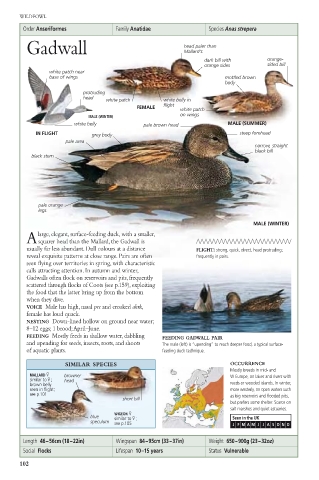
          large, elegant, surface-feeding duck, with a smaller,
        A squarer head than the Mallard, the Gadwall is
        usually far less abundant. Dull colours at a distance  FLIGHT: strong, quick, direct, head protruding;
        reveal exquisite patterns at close range. Pairs are often  frequently in pairs.
        seen flying over territories in spring, with characteristic
        calls attracting attention. In autumn and winter,
        Gadwalls often flock on reservoirs and pits, frequently
        scattered through flocks of Coots (see p.159),exploiting
        the food that the latter bring up from the bottom
        when they dive.
        VOICE Male has high, nasal pee and croaked ahrk,
        female has loud quack.
        NESTING Down-lined hollow on ground near water;
        8–12 eggs; 1 brood;April–June.
        FEEDING Mostly feeds in shallow water, dabbling   FEEDING GADWALL PAIR
        and upending for seeds, insects, roots, and shoots   The male (left) is “upending” to reach deeper food, a typical surface-
        of aquatic plants.               feeding duck technique.
                 SIMILAR SPECIES                          OCCURRENCE
                                                          Mostly breeds in mid- and
        MALLARD 2  browner                                W Europe, on lakes and rivers with
        similar to 2;  head
        brown belly                                       reeds or wooded islands. In winter,
        seen in flight;                                   more westerly, on open waters such
        see p.101                                         as big reservoirs and flooded pits,
                               short bill
                                                          but prefers some shelter. Scarce on
                                                          salt marshes and quiet estuaries.
                             WIGEON 2
                       blue  similar to 2;                 Seen in the UK
                       speculum  see p.105                 J  F  M  A  M  JJ A S O  N  D
       Length  46–56cm (18–22in)  Wingspan  84–95cm (33–37in)  Weight  650–900g (23–32oz)
       Social  Flocks         Lifespan  10–15 years  Status  Vulnerable
      102

