


Page 105 - Complete Birds of Britain and Europe (DK - RSPB)
P. 105
WILDFOWL
       Order Anseriformes     Family Anatidae        Species Anas acuta
        Pintail                                    brown head        grey bill
                                                                     with black
                                              white neck-stripe      lines
                                              and breast
                         long black tail
                         spike
            MALE (WINTER)


                        yellowish patch
             outstretched
             head and neck                                      MALE (WINTER)
                             dull greyish body
              white trailing
              edge
                                                   grey bill
                   FEMALE
                                                  pale breast      plain, pale
                                                                   tawny head
                                                  mottled grey-brown body  grey
                                                  with grey legs
        dark    pale belly                                             bill
        patch                    MALE (SUMMER)
           IN FLIGHT
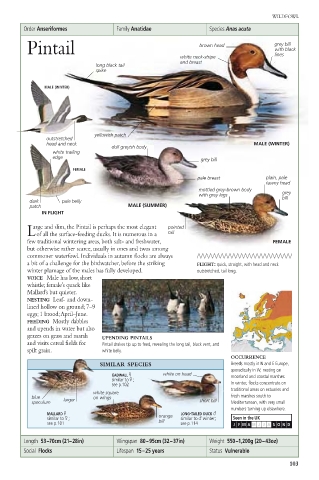
         arge and slim, the Pintail is perhaps the most elegant  pointed
        Lof all the surface-feeding ducks. It is numerous in a   tail
        few traditional wintering areas, both salt- and freshwater,  FEMALE
        but otherwise rather scarce, usually in ones and twos among
        commoner waterfowl. Individuals in autumn flocks are always
        a bit of a challenge for the birdwatcher, before the striking  FLIGHT: quick, straight, with head and neck
        winter plumage of the males has fully developed.  outstretched, tail long.
        VOICE Male has low, short
        whistle; female’s quack like
        Mallard’s but quieter.
        NESTING Leaf- and down-
        lined hollow on ground; 7–9
        eggs; 1 brood;April–June.
        FEEDING Mostly dabbles
        and upends in water but also
        grazes on grass and marsh  UPENDING PINTAILS
        and visits cereal fields for  Pintail drakes tip up to feed, revealing the long tail, black vent, and
        spilt grain.      white belly.
                                                          OCCURRENCE
                          SIMILAR SPECIES                 Breeds mostly in N and E Europe,
                                                          sporadically in W, nesting on
                             GADWALL 2   white on head    moorland and coastal marshes.
                             similar to 2;
                             see p.102                    In winter, flocks concentrate on
                                                          traditional areas on estuaries and
                        white square
         blue    larger   on wings                        fresh marshes south to
         speculum                                  short bill  Mediterranean, with very small
                                                          numbers turning up elsewhere.
             MALLARD 2                  orange  LONG-TAILED DUCK 3
             similar to 2;                    similar to 3winter;  Seen in the UK
             see p.101                  bill   see p.114   JF M A  M J  JA S ON D
       Length  53–70cm (21–28in)  Wingspan  80–95cm (32–37in)  Weight  550–1,200g (20–43oz)
       Social  Flocks         Lifespan  15–25 years  Status  Vulnerable
                                                                         103

