


Page 106 - Complete Birds of Britain and Europe (DK - RSPB)
P. 106
WILDFOWL
       Order Anseriformes     Family Anatidae        Species Anas clypeata
        Shoveler

                                               orange sides
                          streaked, pale       heavy bill with    pale crescent
                                                                  on face
                          brown body
              grey forewings                                dark head
                                                      rufous-tinged
                                                      flanks
                   FEMALE
                                   FEMALE
                                       green-black
           pale blue forewings                            MALE (SUMMER)
                                       head
                             dark rufous
                             flanks                       striking yellow eye
                MALE
                                                                 long, heavy,
                                                                 shovel-like
                                                                 black bill
        IN FLIGHT


           MALE
           (WINTER)
                                                                   bright white
                                                                   breast

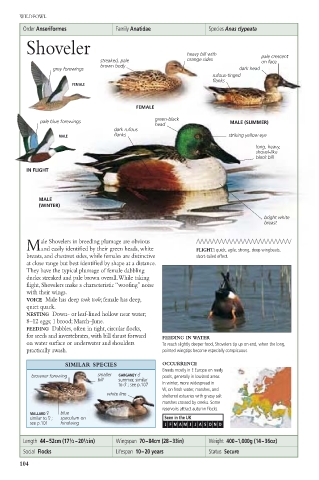
           ale Shovelers in breeding plumage are obvious
        Mand easily identified by their green heads, white  FLIGHT: quick, agile; strong, deep wingbeats,
        breasts, and chestnut sides, while females are distinctive  short-tailed effect.
        at close range but best identified by shape at a distance.
        They have the typical plumage of female dabbling
        ducks: streaked and pale brown overall.While taking
        flight, Shovelers make a characteristic “woofing” noise
        with their wings.
        VOICE Male has deep took took; female has deep,
        quiet quack.
        NESTING Down- or leaf-lined hollow near water;
        8–12 eggs; 1 brood; March–June.
        FEEDING Dabbles, often in tight, circular flocks,
        for seeds and invertebrates, with bill thrust forward   FEEDING IN WATER
        on water surface or underwater and shoulders  To reach slightly deeper food, Shovelers tip up on end, when the long,
        practically awash.               pointed wingtips become especially conspicuous.
                 SIMILAR SPECIES         OCCURRENCE
                                         Breeds mostly in E Europe on reedy
         browner forewing  smaller  GARGANEY 3  pools, generally in lowland areas.
                         bill  summer, similar
                              to 3; see p.107  In winter, more widespread in
                                         W, on fresh water, marshes, and
                            white line
                                         sheltered estuaries with grassy salt
                                         marshes crossed by creeks. Some
                                         reservoirs attract autumn flocks.
        MALLARD 2  blue
        similar to 2;  speculum on        Seen in the UK
        see p.101  hindwing               J  F  M  A  M  JJ A S O  N  D
       Length  44–52cm (17 1 ⁄2 –20 1 ⁄2in)  Wingspan  70–84cm (28–33in)  Weight  400–1,000g (14–36oz)
       Social  Flocks         Lifespan  10–20 years  Status  Secure
      104

