


Page 107 - Complete Birds of Britain and Europe (DK - RSPB)
P. 107
WILDFOWL
       Order Anseriformes     Family Anatidae        Species Anas penelope
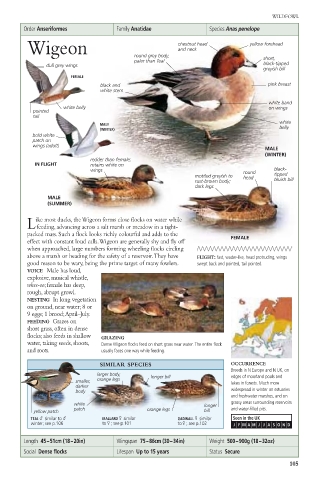
        Wigeon                               chestnut head     yellow forehead
                                             and neck
                                  round grey body,
                                  paler than Teal                 short,
             dull grey wings                                      black-tipped
                                                                  greyish bill
                   FEMALE
                          black and                                 pink breast
                          white stern
                                                                    white band
                 white belly                                        on wings
         pointed
         tail
                                                                      white
                          MALE                                        belly
                          (WINTER)
         bold white
         patch on
         wings (adult)
                                                                   MALE
                                                                   (WINTER)
                       redder than female;
          IN FLIGHT    retains white on
                       wings                                 round   black-
                                                 mottled greyish to  head  tipped
                                                 rust-brown body;    bluish bill
                                                 dark legs
             MALE
             (SUMMER)
          ike most ducks, the Wigeon forms close flocks on water while
        Lfeeding, advancing across a salt marsh or meadow in a tight-
        packed mass. Such a flock looks richly colourful and adds to the  FEMALE
        effect with constant loud calls.Wigeon are generally shy and fly off
        when approached, large numbers forming wheeling flocks circling
        above a marsh or heading for the safety of a reservoir.They have  FLIGHT: fast, wader-like, head protruding, wings
        good reason to be wary, being the prime target of many fowlers.  swept back and pointed, tail pointed.
        VOICE Male has loud,
        explosive, musical whistle,
        whee-oo; female has deep,
        rough, abrupt growl.
        NESTING In long vegetation
        on ground, near water; 8 or
        9 eggs; 1 brood;April–July.
        FEEDING Grazes on
        short grass, often in dense
        flocks; also feeds in shallow  GRAZING
        water, taking seeds, shoots,  Dense Wigeon flocks feed on short grass near water. The entire flock
        and roots.        usually faces one way while feeding.
                          SIMILAR SPECIES                 OCCURRENCE
                                                          Breeds in N Europe and N UK, on
                         larger body;  longer bill        edges of moorland pools and
                    smaller,  orange legs                 lakes in forests. Much more
                    darker
                    body                                  widespread in winter on estuaries
                                                          and freshwater marshes, and on
                   white                            longer  grassy areas surrounding reservoirs
         yellow patch  patch          orange legs   bill  and water-filled pits.
         TEAL 3 similar to 3  MALLARD 2 similar  GADWALL 2 similar  Seen in the UK
         winter; see p.106  to 2; see p.101  to 2; see p.102  J  F  M  A  M  JJ A S O  N  D
       Length  45–51cm (18–20in)  Wingspan  75–86cm (30–34in)  Weight  500–900g (18–32oz)
       Social  Dense flocks   Lifespan  Up to 15 years  Status  Secure
                                                                         105

