


Page 103 - Complete Birds of Britain and Europe (DK - RSPB)
P. 103
WILDFOWL
       Order Anseriformes     Family Anatidae        Species Anas platyrhynchos
        Mallard                                            brown
                                                           head

                           blue speculum
            MALE
                  white
                  underwings                  brown
                                              bill
                                                        MALE (SUMMER)  becomes
                                                   green            browner
                                                   head
                       white    FEMALE   streaked brown
                       tail              body
                                 purple-blue,                       yellow bill
                                 white-edged
                     curly central  speculum  white
             FEMALE  tail feathers            neck-ring
                                                                brown breast


                 dark
                 belly
          IN FLIGHT
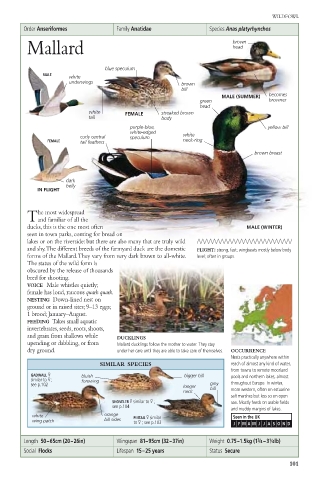
          he most widespread
        Tand familiar of all the
        ducks, this is the one most often                     MALE (WINTER)
        seen in town parks, coming for bread on
        lakes or on the riverside: but there are also many that are truly wild
        and shy.The different breeds of the farmyard duck are the domestic  FLIGHT: strong, fast; wingbeats mostly below body
        forms of the Mallard.They vary from very dark brown to all-white.  level; often in groups.
        The status of the wild form is
        obscured by the release of thousands
        bred for shooting.
        VOICE Male whistles quietly;
        female has loud, raucous quark quark.
        NESTING Down-lined nest on
        ground or in raised sites; 9–13 eggs;
        1 brood; January–August.
        FEEDING Takes small aquatic
        invertebrates, seeds, roots, shoots,
        and grain from shallows while  DUCKLINGS
        upending or dabbling, or from   Mallard ducklings follow the mother to water. They stay
        dry ground.           under her care until they are able to take care of themselves.  OCCURRENCE
                                                          Nests practically anywhere within
                          SIMILAR SPECIES                 reach of almost any kind of water,
                                                          from towns to remote moorland
         GADWALL 2   bluish                    bigger bill  pools and northern lakes, almost
         similar to 2;  forewing
         see p.102                             longer  grey  throughout Europe. In winter,
                                               neck  bill  more western, often on estuarine
                                                          salt marshes but less so on open
                             SHOVELER 2similar to 2;      sea. Mostly feeds on arable fields
                             see p.104
                                                          and muddy margins of lakes.
         white             orange  PINTAIL 2similar        Seen in the UK
         wing patch        bill sides  to 2; see p.103     J  F  M  A  M  JJ A S O  N  D
       Length  50–65cm (20–26in)  Wingspan  81–95cm (32–37in)  Weight  0.75–1.5kg (1 3 ⁄4 –3 1 ⁄4lb)
       Social  Flocks         Lifespan  15–25 years  Status  Secure
                                                                         101

