


Page 17 - Complete Birds of Britain and Europe (DK - RSPB)
P. 17
COURTSHIP AND MATING

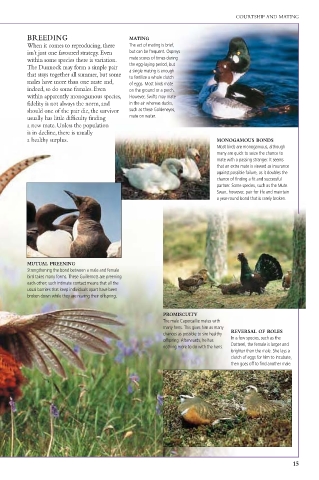
        BREEDING                 MATING
        When it comes to reproducing, there  The act of mating is brief,
        isn’t just one favoured strategy. Even  but can be frequent. Ospreys
        within some species there is variation.  mate scores of times during
        The Dunnock may form a simple pair  the egg-laying period, but
                                 a single mating is enough
        that stays together all summer, but some  to fertilize a whole clutch
        males have more than one mate and,  of eggs. Most birds mate
        indeed, so do some females. Even  on the ground or a perch.
        within apparently monogamous species,  However, Swifts may mate
        fidelity is not always the norm, and  in the air whereas ducks,
        should one of the pair die, the survivor  such as these Goldeneyes,
        usually has little difficulty finding   mate on water.
        a new mate. Unless the population
        is in decline, there is usually
        a healthy surplus.                             MONOGAMOUS BONDS
                                                       Most birds are monogamous, although
                                                       many are quick to seize the chance to
                                                       mate with a passing stranger. It seems
                                                       that an extra mate is viewed as insurance
                                                       against possible failure, as it doubles the
                                                       chance of finding a fit and successful
                                                       partner. Some species, such as the Mute
                                                       Swan, however, pair for life and maintain
                                                       a year-round bond that is rarely broken.


        MUTUAL PREENING
        Strengthening the bond between a male and female
        bird takes many forms. These Guillemots are preening
        each other; such intimate contact means that all the
        usual barriers that keep individuals apart have been
        broken down while they are rearing their offspring.
                                          PROMISCUITY
                                          The male Capercaillie mates with
                                          many hens. This gives him as many
                                          chances as possible to sire healthy  REVERSAL OF ROLES
                                          offspring. Afterwards, he has  In a few species, such as the
                                          nothing more to do with the hens.   Dotterel, the female is larger and
                                                          brighter than the male. She lays a
                                                          clutch of eggs for him to incubate,
                                                          then goes off to find another male.


                                                                          15

