


Page 18 - Complete Birds of Britain and Europe (DK - RSPB)
P. 18
INTRODUCTION

        NESTS AND EGGS

          bird’s life, behaviour, and appearance revolves around
        Afinding a mate and producing eggs in order to ensure
        the survival of its genes.The nest is a safe place to lay those
        eggs, incubate them, and raise the resulting brood, so
        individuals will spend time locating and building the
        perfect nest for their situation.
                                         COLLECTING
                                         MATERIAL
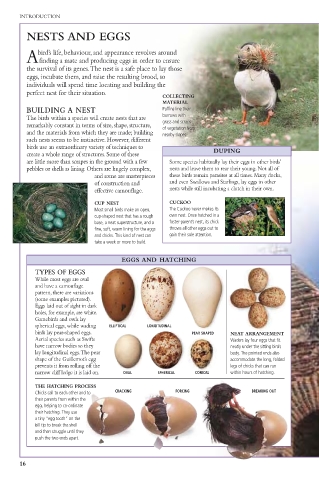
        BUILDING A NEST                  Puffins line their
        The birds within a species will create nests that are  burrows with
                                         grass and scraps
        remarkably constant in terms of size, shape, structure,  of vegetation from
        and the materials from which they are made; building  nearby slopes.
        such nests seems to be instinctive. However, different
        birds use an extraordinary variety of techniques to  DUPING
        create a whole range of structures.Some of these
        are little more than scrapes in the ground with a few  Some species habitually lay their eggs in other birds’
        pebbles or shells as lining.Others are hugely complex,  nests and leave them to rear their young. Not all of
                        and some are masterpieces  these birds remain parasites at all times. Many ducks,
                        of construction and  and even Swallows and Starlings, lay eggs in other
                        effective camouflage.  nests while still incubating a clutch in their own.
                        CUP NEST           CUCKOO
                        Most small birds make an open,  The Cuckoo never makes its
                        cup-shaped nest that has a rough  own nest. Once hatched in a
                        base, a neat superstructure, and a  foster-parent’s nest, its chick
                        fine, soft, warm lining for the eggs  throws all other eggs out to
                        and chicks. This kind of nest can  gain their sole attention.
                        take a week or more to build.

                               EGGS AND HATCHING
          TYPES OF EGGS
          While most eggs are oval
          and have a camouflage
          pattern, there are variations
          (some examples pictured).
          Eggs laid out of sight in dark
          holes, for example, are white.
          Gamebirds and owls lay
          spherical eggs, while wading  ELLIPTICAL  LONGITUDINAL
          birds lay pear-shaped eggs.            PEAR SHAPED  NEAT ARRANGEMENT
          Aerial species such as Swifts                   Waders lay four eggs that fit
          have narrow bodies so they                      neatly under the sitting bird’s
          lay longitudinal eggs.The pear                  body. The pointed ends also
          shape of the Guillemot’s egg                    accommodate the long, folded
          prevents it from rolling off the                legs of chicks that can run
          narrow cliff ledge it is laid on.  OVAL  SPHERICAL  CONICAL  within hours of hatching.

          THE HATCHING PROCESS
          Chicks call to each other and to  CRACKING  FORCING   BREAKING OUT
          their parents from within the
          egg, helping to co-ordinate
          their hatching. They use
          a tiny “egg tooth” on the
          bill tip to break the shell
          and then struggle until they
          push the two ends apart.


      16

