


Page 22 - Complete Birds of Britain and Europe (DK - RSPB)
P. 22
INTRODUCTION

        FLIGHT

          ll the birds that are found within Europe can fly. It is this
        A ability that allows them to travel the globe, moving far and
        wide to exploit seasonal abundances of food while escaping any
        shortages. It is fascinating that these small creatures are able to
        fly across oceans, mountains, and deserts, although such
        journeys often tax them to the limit.Their most significant
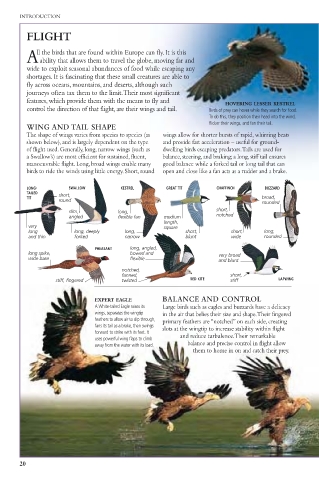
        features,which provide them with the means to fly and  HOVERING LESSER KESTREL
        control the direction of that flight,are their wings and tail.  Birds of prey can hover while they search for food.
                                                     To do this, they position their head into the wind,
                                                     flicker their wings, and fan their tail.
        WING AND TAIL SHAPE
        The shape of wings varies from species to species (as  wings allow for shorter bursts of rapid, whirring beats
        shown below), and is largely dependent on the type   and provide fast acceleration – useful for ground-
        of flight used. Generally, long, narrow wings (such as   dwelling birds escaping predators.Tails are used for
        a Swallow’s) are most efficient for sustained, fluent,  balance, steering, and braking; a long, stiff tail ensures
        manoeuvrable flight. Long, broad wings enable many  good balance while a forked tail or long tail that can
        birds to ride the winds using little energy. Short, round  open and close like a fan acts as a rudder and a brake.

        LONG-     SWALLOW      KESTREL    GREAT TIT    CHAFFINCH   BUZZARD
        TAILED  short,
        TIT                                                       broad,
                round
                                                                  rounded
                                                       short,
                  slim,       long,
                  angled      flexible fan  medium     notched
                                          length,
        very                              square
        long       long, deeply  long,         short,     short,   long,
        and thin   forked       narrow         blunt      wide     rounded
                         PHEASANT  long, angled,
        long spike,              bowed and             very broad
        wide base                flexible
                                                       and blunt
                               notched,
                               fanned,                    short,
               stiff, fingered  twisted         RED KITE  stiff       LAPWING
                         EXPERT EAGLE    BALANCE AND CONTROL
                         A White-tailed Eagle raises its  Large birds such as eagles and buzzards have a delicacy
                         wings, separates the wingtip  in the air that belies their size and shape.Their fingered
                         feathers to allow air to slip through,  primary feathers are “notched” on each side, creating
                         fans its tail as a brake, then swings  slots at the wingtip to increase stability within flight
                         forward to strike with its feet. It
                         uses powerful wing flaps to climb  and reduce turbulence.Their remarkable
                         away from the water with its load.  balance and precise control in flight allow
                                                 them to home in on and catch their prey.


      20

