


Page 21 - Complete Birds of Britain and Europe (DK - RSPB)
P. 21
PLUMAGE


                           ABERRATIONS AND VARIATIONS
          Not all birds are perfect examples of      WEAR AND TEAR
          their species. Some are “aberrant”,        This gull has gaps in its wings and tail.
          because of some genetic deficiency.        Some feathers have been shed and
          “Albinos” are all-white,“albinistic”       not yet replaced while others
          birds are partly white, and “leucistic”    are simply worn and faded,
          birds look pale and washed out through     which alters the
          lack of pigment.“Melanistic” individuals   wing pattern.
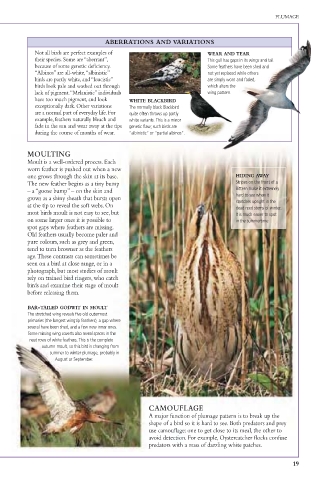
          have too much pigment, and look  WHITE BLACKBIRD
          exceptionally dark. Other variations   The normally black Blackbird
          are a normal part of everyday life. For  quite often throws up partly
          example, feathers naturally bleach and  white variants. This is a minor
          fade in the sun and wear away at the tips  genetic flaw; such birds are
          during the course of months of wear.  “albinistic” or “partial albinos”.

        MOULTING
        Moult is a well-ordered process. Each
        worn feather is pushed out when a new
        one grows through the skin at its base.             HIDING AWAY
        The new feather begins as a tiny bump               Stripes on the front of a
        – a “goose bump” – on the skin and                  Bittern make it extremely
        grows as a shiny sheath that bursts open            hard to see when it
                                                            stretches upright in the
        at the tip to reveal the soft webs. On              dead reed stems of winter.
        most birds moult is not easy to see, but            It is much easier to spot
        on some larger ones it is possible to               in the summertime.
        spot gaps where feathers are missing.
        Old feathers usually become paler and
        pure colours, such as grey and green,
        tend to turn browner as the feathers
        age.These contrasts can sometimes be
        seen on a bird at close range, or in a
        photograph, but most studies of moult
        rely on trained bird ringers, who catch
        birds and examine their stage of moult
        before releasing them.
        BAR-TAILED GODWIT IN MOULT
        The stretched wing reveals five old outermost
        primaries (the longest wingtip feathers), a gap where
        several have been shed, and a few new inner ones.
        Some missing wing coverts also reveal spaces in the
        neat rows of white feathers. This is the complete
           autumn moult, so this bird is changing from
             summer to winter plumage, probably in
               August or September.


                                      CAMOUFLAGE
                                      A major function of plumage pattern is to break up the
                                      shape of a bird so it is hard to see. Both predators and prey
                                      use camouflage: one to get close to its meal, the other to
                                      avoid detection. For example, Oystercatcher flocks confuse
                                      predators with a mass of dazzling white patches.


                                                                          19

