


Page 23 - Complete Birds of Britain and Europe (DK - RSPB)
P. 23
FLIGHT

        TAKING OFF
        Getting airborne uses a lot of energy. Many birds take
        off into the wind from dry land, flapping their wings
        hard in a figure of eight pattern to create lift and
        forward propulsion; others jump from a clifftop or
        tree, moving forwards into the air. Most water birds
        need to run along the surface of the water in order
        to build up the necessary momentum.


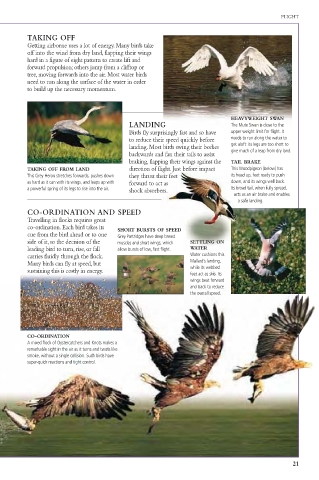
                                                          HEAVYWEIGHT SWAN
                                 LANDING                  The Mute Swan is close to the
                                 Birds fly surprisingly fast and so have   upper weight limit for flight. It
                                 to reduce their speed quickly before  needs to run along the water to
                                 landing. Most birds swing their bodies  get aloft: its legs are too short to
                                                          give much of a leap from dry land.
                                 backwards and fan their tails to assist
                                 braking, flapping their wings against the  TAIL BRAKE
        TAKING OFF FROM LAND     direction of flight. Just before impact  This Woodpigeon (below) has
        This Grey Heron stretches forwards, pushes down   they thrust their feet  its head up, feet ready to push
        as hard as it can with its wings, and leaps up with   forward to act as  down, and its wings well back.
        a powerful spring of its legs to rise into the air.   shock absorbers.  Its broad tail, when fully spread,
                                                           acts as an air brake and enables
                                                            a safe landing.
        CO-ORDINATION AND SPEED
        Travelling in flocks requires great
        co-ordination. Each bird takes its
                              SHORT BURSTS OF SPEED
        cue from the bird ahead or to one  Grey Partridges have deep breast
        side of it, so the decision of the  muscles and short wings, which   SETTLING ON
        leading bird to turn, rise, or fall  allow bursts of low, fast flight.   WATER
        carries fluidly through the flock.      Water cushions this
                                                Mallard’s landing,
        Many birds can fly at speed,but
                                                while its webbed
        sustaining this is costly in energy.
                                                feet act as skis. Its
                                                wings beat forward
                                                and back to reduce
                                                the overall speed.


        CO-ORDINATION
        A mixed flock of Oystercatchers and Knots makes a
        remarkable sight in the air as it turns and twists like
        smoke, without a single collision. Such birds have
        super-quick reactions and tight control.


                                                                          21

