


Page 191 - Complete Birds of Britain and Europe (DK - RSPB)
P. 191
WADERS
       Order Charadriiformes  Family Scolopacidae    Species Tringa nebularia
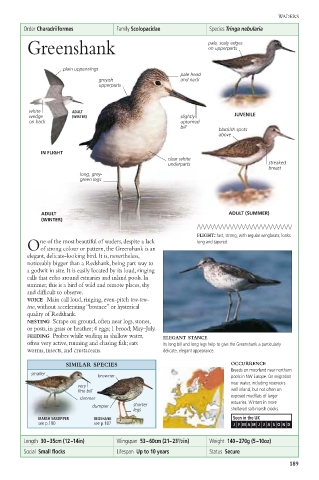
        Greenshank                                   pale, scaly edges
                                                     on upperparts

                 plain upperwings
                                              pale head
                          greyish             and neck
                          upperparts


        white      ADULT
        wedge      (WINTER)                   slightly     JUVENILE
        on back                               upturned
                                              bill
                                                       blackish spots
                                                       above
           IN FLIGHT
                                           clear white
                                           underparts               streaked
                                                                    breast
                     long, grey-
                     green legs


           ADULT                                          ADULT (SUMMER)
           (WINTER)
                                                  FLIGHT: fast, strong, with regular wingbeats; looks
           ne of the most beautiful of waders, despite a lack   long and tapered.
        Oof strong colour or pattern, the Greenshank is an
        elegant, delicate-looking bird. It is, nevertheless,
        noticeably bigger than a Redshank, being part way to
        a godwit in size. It is easily located by its loud, ringing
        calls that echo around estuaries and inland pools. In
        summer, this is a bird of wild and remote places, shy
        and difficult to observe.
        VOICE Main call loud, ringing, even-pitch tew-tew-
        tew, without accelerating “bounce” or hysterical
        quality of Redshank.
        NESTING Scrape on ground, often near logs, stones,
        or posts, in grass or heather; 4 eggs; 1 brood; May–July.
        FEEDING Probes while wading in shallow water,  ELEGANT STANCE
        often very active, running and chasing fish; eats  Its long bill and long legs help to give the Greenshank a particularly
        worms, insects, and crustaceans.  delicate, elegant appearance.
                 SIMILAR SPECIES                          OCCURRENCE
                                                          Breeds on moorland near northern
         smaller
                         browner                          pools in NW Europe. On migration
                                                          near water, including reservoirs
                    very
                    fine bill                             well inland, but not often on
                                                          exposed mudflats of larger
                     slimmer                              estuaries. Winters in more
                        dumpier   shorter
                                  legs                    sheltered salt-marsh creeks.
           MARSH SANDPIPER  REDSHANK                       Seen in the UK
           see p.190    see p.187                          J  F  M  A  M  JJ A S O  N  D
       Length  30–35cm (12–14in)  Wingspan  53–60cm (21–23 1 ⁄2in)  Weight  140–270g (5–10oz)
       Social  Small flocks   Lifespan  Up to 10 years  Status  Secure
                                                                         189

