


Page 190 - Complete Birds of Britain and Europe (DK - RSPB)
P. 190
WADERS
       Order Charadriiformes  Family Scolopacidae    Species Tringa erythropus
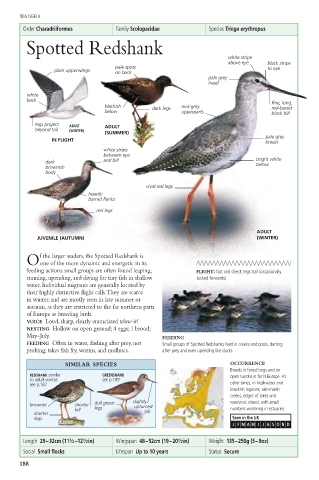
        Spotted Redshank

                                                          white stripe
                                                          above eye  black stripe
                              pale spots                           to eye
               plain upperwings
                              on back
                                                     pale grey
                                                     head
        white
        back                                                        fine, long,
                           blackish    dark legs  mid-grey          red-based
                           below              upperparts            black bill
          legs project  ADULT  ADULT
          beyond tail   (WINTER)  (SUMMER)
                                                                   pale grey
              IN FLIGHT
                                                                   breast
                           white stripe
                           between eye
            dark           and bill                              bright white
                                                                 below
            brownish
            body
                                     vivid red legs
                       heavily
                       barred flanks
                         red legs
                                                                 ADULT
          JUVENILE (AUTUMN)                                      (WINTER)
           f the larger waders, the Spotted Redshank is
        Oone of the more dynamic and energetic in its
        feeding actions: small groups are often found leaping,  FLIGHT: fast and direct; legs trail (occasionally
        running, upending, and diving for tiny fish in shallow  tucked forwards).
        water. Individual migrants are generally located by
        their highly distinctive flight calls.They are scarce
        in winter, and are mostly seen in late summer or
        autumn, as they are restricted to the far northern parts
        of Europe as breeding birds.
        VOICE Loud, sharp, clearly enunciated tchew-it!
        NESTING Hollow on open ground; 4 eggs; 1 brood;
        May–July.                        FEEDING
        FEEDING Often in water, dashing after prey, not  Small groups of Spotted Redshanks feed in creeks and pools, darting
        probing; takes fish fry, worms, and molluscs.  after prey and even upending like ducks.
                 SIMILAR SPECIES                          OCCURRENCE
                                                          Breeds in forest bogs and on
        REDSHANK similar  GREENSHANK                      open tundra in far N Europe. At
        to adult winter;   see p.189
        see p.187                                         other times, in freshwater and
                                                          brackish lagoons, salt-marsh
                                                          creeks, edges of lakes and
        browner     shorter  dull green  slightly         reservoirs inland, with small
                                  upturned
                    bill  legs                            numbers wintering in estuaries.
          shorter                    bill
          legs                                             Seen in the UK
                                                           J  F  M  A  M  JJ A S O  N  D
       Length  29–32cm (11 1 ⁄2 –12 1 ⁄2in)  Wingspan  48–52cm (19–20 1 ⁄2in)  Weight  135–250g (5–9oz)
       Social  Small flocks   Lifespan  Up to 10 years  Status  Secure
      188

