


Page 192 - Complete Birds of Britain and Europe (DK - RSPB)
P. 192
WADERS
       Order Charadriiformes  Family Scolopacidae    Species Tringa stagnatilis
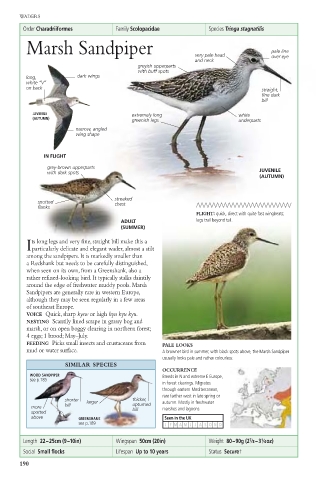
        Marsh Sandpiper                                             pale line
                                                 very pale head     over eye
                                                 and neck
                                   greyish upperparts
                                   with buff spots
       long,        dark wings
       white “V”
       on back                                                    straight,
                                                                  fine dark
                                                                  bill
         JUVENILE                 extremely long            white
         (AUTUMN)                 greenish legs             underparts
                    narrow, angled
                    wing shape

            IN FLIGHT
             grey-brown upperparts
             with dark spots                                     JUVENILE
                                                                 (AUTUMN)
                              streaked
          spotted             chest
          flanks
                                                  FLIGHT: quick, direct with quite fast wingbeats;
                               ADULT              legs trail beyond tail.
                               (SUMMER)
         ts long legs and very fine, straight bill make this a
        Iparticularly delicate and elegant wader, almost a stilt
        among the sandpipers. It is markedly smaller than
        a Redshank but needs to be carefully distinguished,
        when seen on its own, from a Greenshank, also a
        rather refined-looking bird. It typically stalks daintily
        around the edge of freshwater muddy pools. Marsh
        Sandpipers are generally rare in western Europe,
        although they may be seen regularly in a few areas
        of southeast Europe.
        VOICE Quick, sharp kyew or high kyu kyu kyu.
        NESTING Scantily lined scrape in grassy bog and
        marsh, or on open boggy clearing in northern forest;
        4 eggs; 1 brood; May–July.
        FEEDING Picks small insects and crustaceans from  PALE LOOKS
        mud or water surface.            A browner bird in summer, with black spots above, the Marsh Sandpiper
                                         ususally looks pale and rather colourless.
                 SIMILAR SPECIES
                                         OCCURRENCE
        WOOD SANDPIPER                   Breeds in N and extreme E Europe,
        see p.185
                                         in forest clearings. Migrates
                                         through eastern Mediterranean,
                                         rare farther west in late spring or
                 shorter  larger  thicker,  autumn. Mostly in freshwater
                 bill             upturned
         more                     bill   marshes and lagoons.
         spotted
         above       GREENSHANK           Seen in the UK
                     see p.189            JF M A  M J  JA S ON D
       Length  22–25cm (9–10in)  Wingspan  50cm (20in)  Weight  80–90g (2 7 ⁄8 –3 1 ⁄4oz)
       Social  Small flocks   Lifespan  Up to 10 years  Status  Secure†
      190

