


Page 195 - Complete Birds of Britain and Europe (DK - RSPB)
P. 195
WADERS
       Order Charadriiformes  Family Scolopacidae    Species Numenius arquata
        Curlew


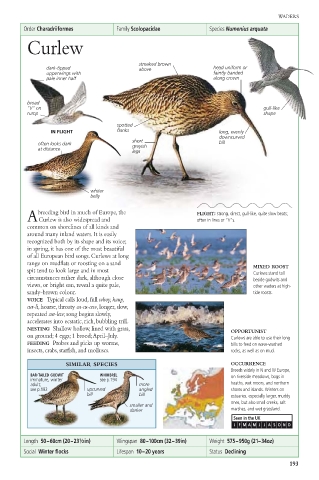
                                    streaked brown
             dark-tipped            above             head uniform or
             upperwings with                          faintly banded
             pale inner half                          along crown

        broad
        “V” on                                                    gull-like
        rump                                                      shape
                              spotted
              IN FLIGHT       flanks                   long, evenly
                                                       downcurved
                                  short
          often looks dark        greyish              bill
          at distance
                                  legs


                       whiter
                       belly
          breeding bird in much of Europe, the    FLIGHT: strong, direct, gull-like, quite slow beats;
        ACurlew is also widespread and            often in lines or “V”s.
        common on shorelines of all kinds and
        around many inland waters. It is easily
        recognized both by its shape and its voice;
        in spring, it has one of the most beautiful
        of all European bird songs. Curlews at long
        range on mudflats or roosting on a sand                 MIXED ROOST
        spit tend to look large and in most                     Curlews stand tall
        circumstances rather dark, although close               beside godwits and
        views, or bright sun, reveal a quite pale,              other waders at high-
        sandy-brown colour.                                     tide roosts.
        VOICE Typical calls loud, full whoy, haup,
        cur-li, hoarse, throaty cu-cu-cew, longer, slow,
        repeated cur-lew; song begins slowly,
        accelerates into ecstatic, rich, bubbling trill.
        NESTING Shallow hollow, lined with grass,         OPPORTUNIST
        on ground; 4 eggs; 1 brood;April–July.            Curlews are able to use their long
        FEEDING Probes and picks up worms,                bills to feed on wave-washed
        insects, crabs, starfish, and molluscs.           rocks, as well as on mud.
                 SIMILAR SPECIES                          OCCURRENCE
                                                          Breeds widely in N and W Europe,
         BAR-TAILED GODWIT  WHIMBREL                      on riverside meadows, bogs in
         immature, winter  see p.194
         adult;                     more                  heaths, wet moors, and northern
         see p.192     upcurved     angled                shores and islands. Winters on
                       bill         bill                  estuaries, especially larger, muddy
                                                          ones, but also small creeks, salt
                                 smaller and
                                 darker                   marshes, and wet grassland.
                                                           Seen in the UK
                                                           J  F  M  A  M  JJ A S O  N  D
       Length  50–60cm (20–23 1 ⁄2in)  Wingspan  80–100cm (32–39in)  Weight  575–950g (21–34oz)
       Social  Winter flocks  Lifespan  10–20 years  Status  Declining
                                                                         193

