


Page 193 - Complete Birds of Britain and Europe (DK - RSPB)
P. 193
WADERS
       Order Charadriiformes  Family Scolopacidae    Species Limosa limosa
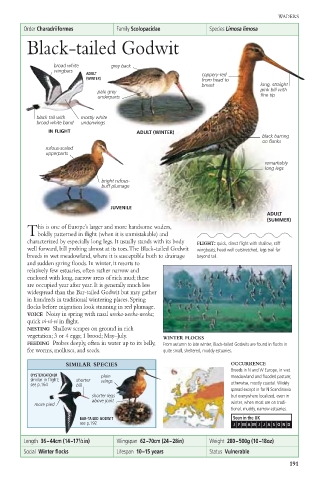
        Black-tailed Godwit


              broad white    grey back
              wingbars
                      ADULT                        coppery-red
                      (WINTER)                     from head to
                                                   breast         long, straight
                         pale grey                                pink bill with
                         underparts                               fine tip
          black tail with  mostly white
          broad white band  underwings
             IN FLIGHT             ADULT (WINTER)
                                                                  black barring
                                                                  on flanks
            rufous-scaled
            upperparts
                                                                   remarkably
                                                                   long legs
                          bright rufous-
                          buff plumage

                            JUVENILE
                                                                   ADULT
                                                                   (SUMMER)
          his is one of Europe’s larger and more handsome waders,
        Tboldly patterned in flight (when it is unmistakable) and
        characterized by especially long legs. It usually stands with its body  FLIGHT: quick, direct flight with shallow, stiff
        well forward, bill probing almost at its toes.The Black-tailed Godwit  wingbeats; head well outstretched, legs trail far
        breeds in wet meadowland, where it is susceptible both to drainage  beyond tail.
        and sudden spring floods. In winter, it resorts to
        relatively few estuaries, often rather narrow and
        enclosed with long, narrow areas of rich mud; these
        are occupied year after year. It is generally much less
        widespread than the Bar-tailed Godwit but may gather
        in hundreds in traditional wintering places. Spring
        flocks before migration look stunning in red plumage.
        VOICE Noisy in spring with nasal weeka-weeka-weeka;
        quick vi-vi-vi in flight.
        NESTING Shallow scrapes on ground in rich
        vegetation; 3 or 4 eggs; 1 brood; May–July.  WINTER FLOCKS
        FEEDING Probes deeply, often in water up to its belly,  From autumn to late winter, Black-tailed Godwits are found in flocks in
        for worms, molluscs, and seeds.   quite small, sheltered, muddy estuaries.
                 SIMILAR SPECIES                          OCCURRENCE
                                                          Breeds in N and W Europe, in wet
         OYSTERCATCHER    plain                           meadowland and flooded pasture;
         similar in flight;  shorter  wings
         see p.164  bill                                  otherwise, mostly coastal. Widely
                                                          spread except in far N Scandinavia
                        shorter legs                      but everywhere localized, even in
                        above joint                       winter, when most are on tradi-
          more pied
                                                          tional, muddy, narrow estuaries.
                     BAR-TAILED GODWIT                     Seen in the UK
                     see p.192                             J  F  M  A  M  JJ A S O  N  D
       Length  36–44cm (14–17 1 ⁄2in)  Wingspan  62–70cm (24–28in)  Weight  280–500g (10–18oz)
       Social  Winter flocks  Lifespan  10–15 years  Status  Vulnerable
                                                                         191

