


Page 194 - Complete Birds of Britain and Europe (DK - RSPB)
P. 194
WADERS
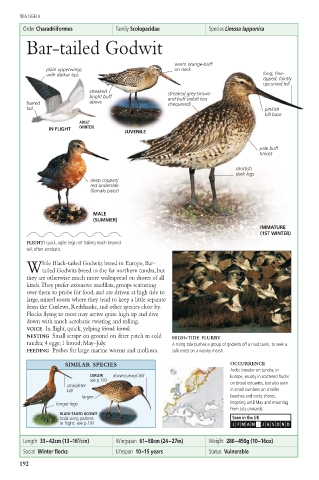
       Order Charadriiformes  Family Scolopacidae    Species Limosa lapponica
        Bar-tailed Godwit


                                            warm orange-buff
             plain upperwings               on neck
             with darker tips                                     long, fine-
                                                                  tipped, faintly
                                                                  upcurved bill
                       streaked            streaked grey-brown
                       bright buff         and buff (adult less
        barred         above               chequered)
        tail                                                       pinkish
                                                                   bill base
                     ADULT
             IN FLIGHT  (WINTER)
                                JUVENILE
                                                                 pale buff
                                                                 breast
                                                            shortish
                                                            dark legs
                       deep coppery
                       red underside
                       (female paler)

                        MALE
                        (SUMMER)
                                                                  IMMATURE
                                                                  (1ST WINTER)
        FLIGHT: quick, agile; legs not trailing much beyond
        tail; often acrobatic.
            hile Black-tailed Godwits breed in Europe, Bar-
        Wtailed Godwits breed in the far northern tundra, but
        they are otherwise much more widespread on shores of all
        kinds.They prefer extensive mudflats, groups scattering
        over them to probe for food, and are driven at high tide to
        large, mixed roosts where they tend to keep a little separate
        from the Curlews, Redshanks, and other species close by.
        Flocks flying to roost may arrive quite high up and dive
        down with much acrobatic twisting and rolling.
        VOICE In flight, quick, yelping kirruk kirruk.
        NESTING Small scrape on ground on drier patch in cold  HIGH-TIDE FLURRY
        tundra; 4 eggs; 1 brood; May–July.  A rising tide pushes a group of godwits off a mud bank, to seek a
        FEEDING Probes for large marine worms and molluscs.  safe roost on a nearby marsh.
                 SIMILAR SPECIES                          OCCURRENCE
                                                          Arctic breeder on tundra; in
                       CURLEW  downcurved bill            Europe, mostly in scattered flocks
                       see p.193                          on broad estuaries, but also seen
                  straighter
                  bill                                    in small numbers on smaller
                     larger                               beaches and rocky shores,
               longer legs                                lingering until May and returning
                                                          from July onwards.
                BLACK-TAILED GODWIT
                bold wing pattern                          Seen in the UK
                in flight; see p.191                       JF M A  M J  JA S ON D
       Length  33–42cm (13–16 1 ⁄2in)  Wingspan  61–68cm (24–27in)  Weight  280–450g (10–16oz)
       Social  Winter flocks  Lifespan  10–15 years  Status  Vulnerable
      192

