


Page 210 - Complete Birds of Britain and Europe (DK - RSPB)
P. 210
SKUAS, GULLS,AND TERNS
       Order Charadriiformes  Family Laridae         Species Larus melanocephalus
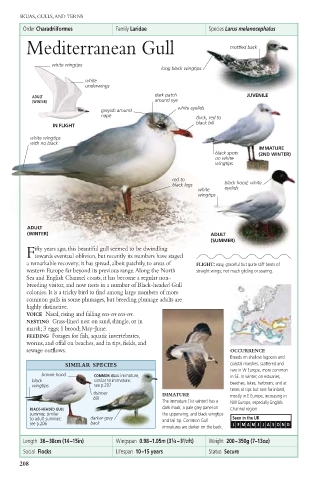
        Mediterranean Gull                                mottled back


              white wingtips
                                         long black wingtips
                      white
                      underwings
                                       dark patch             JUVENILE
         ADULT
         (WINTER)                      around eye
                                             white eyelids
                          greyish around
                          nape
                                                  thick, red to
                                                  black bill
              IN FLIGHT
         white wingtips
         with no black
                                                                 IMMATURE
                                                      black spots  (2ND WINTER)
                                                      on white
                                                      wingtips
                                            red to
                                            black legs   black hood; white
                                                  white  eyelids
                                                  wingtips

        ADULT
        (WINTER)                                     ADULT
                                                     (SUMMER)
          ifty years ago, this beautiful gull seemed to be dwindling
        Ftowards eventual oblivion, but recently its numbers have staged
        a remarkable recovery; it has spread, albeit patchily, to areas of  FLIGHT: easy, graceful but quite stiff beats of
        western Europe far beyond its previous range.Along the North  straight wings; not much gliding or soaring.
        Sea and English Channel coasts, it has become a regular non-
        breeding visitor, and now nests in a number of Black-headed Gull
        colonies. It is a tricky bird to find among large numbers of more
        common gulls in some plumages, but breeding plumage adults are
        highly distinctive.
        VOICE Nasal, rising and falling eeu-err eeu-err.
        NESTING Grass-lined nest on sand, shingle, or in
        marsh; 3 eggs; 1 brood; May–June.
        FEEDING Forages for fish, aquatic invertebrates,
        worms, and offal on beaches, and in tips, fields, and
        sewage outflows.                                  OCCURRENCE
                                                          Breeds on shallow lagoons and
                 SIMILAR SPECIES                          coastal marshes, scattered and
                                                          rare in W Europe, more common
           brown hood   COMMON GULL immature,             in SE. In winter, on estuaries,
         black          similar to immature;              beaches, lakes, harbours, and at
         wingtips       see p.207
                                                          times at tips but rare far inland,
                        thinner          IMMATURE         mostly in E Europe, increasing in
                        bill
                                         The immature (1st winter) has a  NW Europe, especially English
        BLACK-HEADED GULL                dark mask, a pale grey panel on  Channel region.
        summer, similar                  the upperwing, and black wingtips
        to adult summer;  darker grey    and tail tip. Common Gull  Seen in the UK
        see p.206      back                                J  F  M  A  M  JJ A S O  N  D
                                         immatures are darker on the back.
       Length  36–38cm (14–15in)  Wingspan  0.98–1.05m (3 1 ⁄4 –3 1 ⁄2ft)  Weight  200–350g (7–13oz)
       Social  Flocks         Lifespan  10–15 years  Status  Secure
      208

