


Page 211 - Complete Birds of Britain and Europe (DK - RSPB)
P. 211
SKUAS, GULLS,AND TERNS
       Order Charadriiformes  Family Laridae         Species Larus argentatus
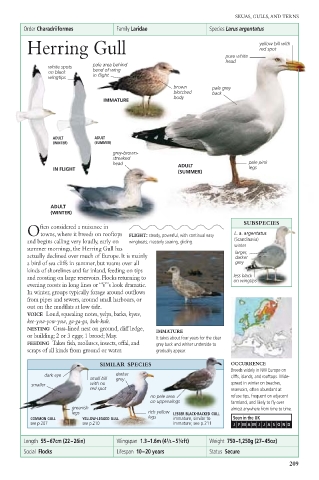
        Herring Gull                                             yellow bill with
                                                                 red spot
                                                         pure white
                                                         head
             white spots  pale area behind
             on black   bend of wing
             wingtips   in flight
                                            brown     pale grey
                                            blotched  back
                                            body
                           IMMATURE


              ADULT      ADULT
              (WINTER)   (SUMMER)
                             grey-brown-
                             streaked
                             head            ADULT             pale pink
              IN FLIGHT                                        legs
                                             (SUMMER)


              ADULT
              (WINTER)
                                                              SUBSPECIES
           ften considered a nuisance in
        Otowns, where it breeds on rooftops  FLIGHT: steady, powerful, with continual easy  L. a. argentatus
        and begins calling very loudly, early on  wingbeats; masterly soaring, gliding.  (Scandinavia)
        summer mornings, the Herring Gull has              winter
                                                           larger,
        actually declined over much of Europe. It is mainly  darker
        a bird of sea cliffs in summer, but roams over all  grey
        kinds of shorelines and far inland, feeding on tips
        and roosting on large reservoirs.Flocks returning to  less black
                                                           on wingtips
        evening roosts in long lines or “V”s look dramatic.
        In winter, groups typically forage around outflows
        from pipes and sewers, around small harbours, or
        out on the mudflats at low tide.
        VOICE Loud, squealing notes, yelps, barks, kyow,
        kee-yow-yow-yow, ga-ga-ga, kuk-kuk.
        NESTING Grass-lined nest on ground, cliff ledge,  IMMATURE
        or building; 2 or 3 eggs; 1 brood; May.  It takes about four years for the clear
        FEEDING Takes fish, molluscs, insects, offal, and  grey back and whiter underside to
        scraps of all kinds from ground or water.  gradually appear.
                          SIMILAR SPECIES                 OCCURRENCE
                                                          Breeds widely in NW Europe on
            dark eye          darker                      cliffs, islands, and rooftops. Wide-
                       small bill  grey
         smaller       with no                            spread in winter on beaches,
                       red spot                           reservoirs, often abundant at
                                      no pale area        refuse tips, frequent on adjacent
                                      on upperwings       farmland, and likely to fly over
                   greenish                               almost anywhere from time to time.
                   legs               rich yellow  LESSER BLACK-BACKED GULL
         COMMON GULL  YELLOW-LEGGED GULL  legs  immature, similar to  Seen in the UK
         see p.207   see p.210              immature; see p.211  J  F  M  A  M  JJ A S O  N  D
       Length  55–67cm (22–26in)  Wingspan  1.3–1.6m (4 1 ⁄4 –5 1 ⁄4ft)  Weight  750–1,250g (27–45oz)
       Social  Flocks         Lifespan  10–20 years  Status  Secure
                                                                         209

