


Page 26 - Complete Birds of Britain and Europe (DK - RSPB)
P. 26
INTRODUCTION

        SONG AND CALLS

          irds’ voices are remarkably far-carrying and can
        Bconvey a variety of messages to other birds.A bird
        will use many vocal sounds but each type is normally
        constant within a species.This helps us to use song and
        calls to identify individual birds. Usually it is the males
        that sing to attract females for mating and to repel
        other males from their nesting area.
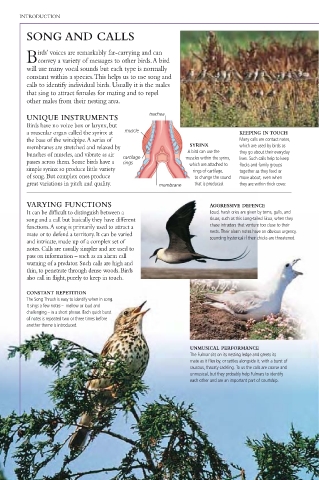
                                      trachea
        UNIQUE INSTRUMENTS
        Birds have no voice box or larynx, but
        a muscular organ called the syrinx at  muscle       KEEPING IN TOUCH
        the base of the windpipe.A series of                Many calls are contact notes,
        membranes are stretched and relaxed by  SYRINX      which are used by birds as
                                                A bird can use the
        bunches of muscles, and vibrate as air  cartilage  muscles within the syrinx,  they go about their everyday
        passes across them. Some birds have a  rings  which are attached to  lives. Such calls help to keep
                                                            flocks and family groups
        simple syrinx so produce little variety  rings of cartilage,   together as they feed or
        of song. But complex ones produce        to change the sound  move about, even when
        great variations in pitch and quality.  membrane  that is produced.  they are within thick cover.
        VARYING FUNCTIONS                            AGGRESSIVE DEFENCE
        It can be difficult to distinguish between a  Loud, harsh cries are given by terns, gulls, and
        song and a call but basically they have different  skuas, such as this Long-tailed Skua, when they
        functions.A song is primarily used to attract a  chase intruders that venture too close to their
        mate or to defend a territory. It can be varied  nests. Their alarm notes have an obvious urgency,
                                                     sounding hysterical if their chicks are threatened.
        and intricate, made up of a complex set of
        notes. Calls are usually simpler and are used to
        pass on information – such as an alarm call
        warning of a predator. Such calls are high and
        thin, to penetrate through dense woods. Birds
        also call in flight, purely to keep in touch.
        CONSTANT REPETITION
        The Song Thrush is easy to identify when in song.
        It sings a few notes –  mellow or loud and
        challenging – in a short phrase. Each quick burst
        of notes is repeated two or three times before
        another theme is introduced.


                                                UNMUSICAL PERFORMANCE
                                                The Fulmar sits on its nesting ledge and greets its
                                                mate as it flies by, or settles alongside it, with a burst of
                                                raucous, throaty cackling. To us the calls are coarse and
                                                unmusical, but they probably help Fulmars to identify
                                                each other and are an important part of courtship.


      24

