


Page 25 - Complete Birds of Britain and Europe (DK - RSPB)
P. 25
FEEDING

        LAND FEEDERS                      BERRY EATERS
        Birds of all shapes and sizes are land feeders. Many,  Redwings and other thrushes gorge themselves
        such as pigeons and finches, feed on the ground as  in the autumn and early winter if the berry
        well as in trees, depending on the time of year. Geese,  crop is good. If the crop fails
        some waders, and pipits are, on the other hand,  then they must turn to
                                          worms and other food,
        exclusively ground birds; some birds, such as bustards  or fly great distances in
        and cranes, are so big that they have no option but to  search of berries and
        stay on the ground. Others, such as woodpeckers,  fruit elsewhere.
        prefer trees, and chip away at bark to locate insects.
        The type of food that they eat affects the way that bird
        communities feed. Some take in food that is spread
        over a wide area but is not very abundant, so they
        disperse themselves in order to avoid competing with
        each other. Others eat food, such as seeds, that is only
        located in a few places. It is often in plentiful supply,  TEARING FLESH
        however, which allows them to feed in sociable flocks.  Birds of prey catch food with their feet, which have incredibly
                                          sharp talons. However, they often kill the prey and rip it apart
                                          using their hooked bills.


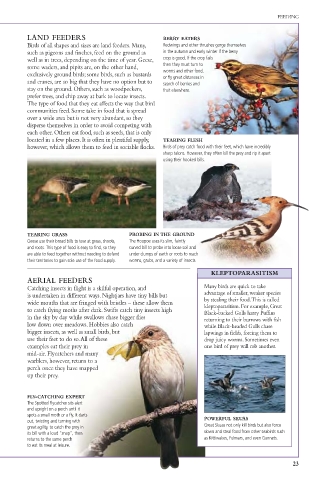
        TEARING GRASS            PROBING IN THE GROUND
        Geese use their broad bills to tear at grass, shoots,  The Hoopoe uses its slim, faintly
        and roots. This type of food is easy to find, so they  curved bill to probe into loose soil and
        are able to feed together without needing to defend  under clumps of earth or roots to reach
        their territories to gain sole use of the food supply.   worms, grubs, and a variety of insects.
                                                     KLEPTOPARASITISM
        AERIAL FEEDERS
        Catching insects in flight is a skilful operation, and   Many birds are quick to take
        is undertaken in different ways. Nightjars have tiny bills but  advantage of smaller, weaker species
        wide mouths that are fringed with bristles – these allow them  by stealing their food.This is called
                                                    kleptoparasitism. For example, Great
        to catch flying moths after dark. Swifts catch tiny insects high  Black-backed Gulls harry Puffins
        in the sky by day while swallows chase bigger flies  returning to their burrows with fish
        low down over meadows. Hobbies also catch   while Black-headed Gulls chase
        bigger insects, as well as small birds, but   lapwings in fields, forcing them to
        use their feet to do so.All of these        drop juicy worms. Sometimes even
        examples eat their prey in                  one bird of prey will rob another.
        mid-air. Flycatchers and many
        warblers, however, return to a
        perch once they have snapped
        up their prey.

        FLY-CATCHING EXPERT
        The Spotted Flycatcher sits alert
        and upright on a perch until it
        spots a small moth or a fly. It darts
        out, twisting and turning with              POWERFUL SKUAS
        great agility, to catch the prey in         Great Skuas not only kill birds but also force
        its bill with a loud “snap”, then           down and steal food from other seabirds such
        returns to the same perch                   as Kittiwakes, Fulmars, and even Gannets.
        to eat its meal at leisure.

                                                                          23 23

