


Page 24 - Complete Birds of Britain and Europe (DK - RSPB)
P. 24
INTRODUCTION

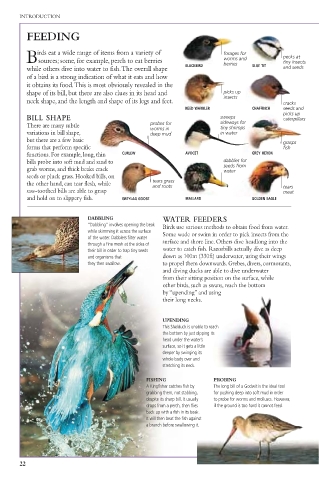
        FEEDING

          irds eat a wide range of items from a variety of   forages for
        Bsources; some, for example, perch to eat berries  worms and   pecks at
                                                                       tiny insects
                                               BLACKBIRD  berries  BLUE TIT
        while others dive into water to fish.The overall shape         and seeds
        of a bird is a strong indication of what it eats and how
        it obtains its food.This is most obviously revealed in the
        shape of its bill, but there are also clues in its head and  picks up
                                                         insects
        neck shape, and the length and shape of its legs and feet.     cracks
                                               REED WARBLER     CHAFFINCH  seeds and
                                                                       picks up
        BILL SHAPE                                      sweeps         caterpillars
        There are many subtle         probes for        sideways for
                                                        tiny shrimps
                                      worms in
        variations in bill shape,     deep mud          in water
        but there are a few basic                                      grasps
        forms that perform specific                                    fish
        functions. For example, long, thin  CURLEW  AVOCET      GREY HERON
        bills probe into soft mud and sand to            dabbles for
        grab worms, and thick beaks crack                seeds from
                                                         water
        seeds or pluck grass. Hooked bills, on
        the other hand, can tear flesh, while  tears grass             tears
                                       and roots
        saw-toothed bills are able to grasp                            meat
        and hold on to slippery fish.  GREYLAG GOOSE  MALLARD   GOLDEN EAGLE
                       DABBLING          WATER FEEDERS
                       “Dabbling” involves opening the beak  Birds use various methods to obtain food from water.
                       while skimming it across the surface  Some wade or swim in order to pick insects from the
                       of the water. Dabblers filter water
                       through a fine mesh at the sides of  surface and shore line. Others dive headlong into the
                       their bill in order to trap tiny seeds  water to catch fish. Razorbills actually dive as deep
                       and organisms that  down as 100m (330ft) underwater, using their wings
                       they then swallow.  to propel them downwards. Grebes, divers, cormorants,
                                         and diving ducks are able to dive underwater
                                         from their sitting position on the surface, while
                                         other birds, such as swans, reach the bottom
                                         by “upending” and using
                                         their long necks.
                                         UPENDING
                                         This Shelduck is unable to reach
                                         the bottom by just dipping its
                                         head under the water’s
                                         surface, so it gets a little
                                         deeper by swinging its
                                         whole body over and
                                         stretching its neck.
                                     FISHING          PROBING
                                     A Kingfisher catches fish by  The long bill of a Godwit is the ideal tool
                                     grabbing them, not stabbing,  for pushing deep into soft mud in order
                                     despite its sharp bill. It usually  to probe for worms and molluscs. However,
                                     drops from a perch, then flies  if the ground is too hard it cannot feed.
                                     back up with a fish in its beak.
                                     It will then beat the fish against
                                     a branch before swallowing it.


      22 22

