


Page 28 - Complete Birds of Britain and Europe (DK - RSPB)
P. 28
INTRODUCTION

        MIGRATION

           orthern Europe is full of insect food in summer,
        Nwhen long days allow birds time to feed both
        themselves and their young. Such resources are too
        good to miss, but few birds can survive in the far north
        in winter when the days become short and cold. Only
        by huge movements of millions of birds can they exploit
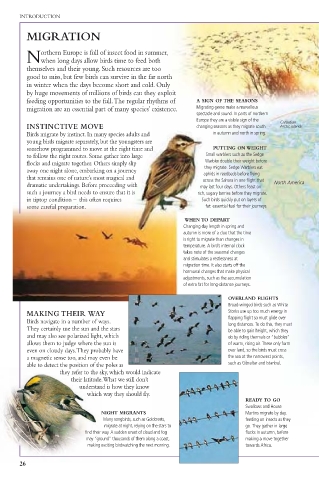
        feeding opportunities to the full.The regular rhythms of  A SIGN OF THE SEASONS
        migration are an essential part of many species’ existence.  Migrating geese make a marvellous
                                                  spectacle and sound. In parts of northern
                                                  Europe they are a visible sign of the  Canadian
        INSTINCTIVE MOVE                          changing seasons as they migrate south  Arctic islands
        Birds migrate by instinct. In many species adults and  in autumn and north in spring.
        young birds migrate separately, but the youngsters are
        somehow programmed to move at the right time and  PUTTING ON WEIGHT
        to follow the right routes. Some gather into large  Small warblers such as the Sedge
        flocks and migrate together. Others simply slip  Warbler double their weight before
                                                    they migrate. Sedge Warblers eat
        away one night alone, embarking on a journey  aphids in reedbeds before flying
        that remains one of nature’s most magical and  across the Sahara in one flight that
        dramatic undertakings. Before proceeding with  may last four days. Others feast on  North America
        such a journey a bird needs to ensure that it is  rich, sugary berries before they migrate.
        in tiptop condition – this often requires   Such birds quickly put on layers of
        some careful preparation.                   fat: essential fuel for their journeys.
                                               WHEN TO DEPART
                                               Changing day length in spring and
                                               autumn is more of a clue that the time
                                               is right to migrate than changes in
                                               temperature. A bird’s internal clock
                                               takes note of the seasonal changes
                                               and stimulates a restlessness at
                                               migration time. It also starts off the
                                               hormonal changes that make physical
                                               adjustments, such as the accumulation
                                               of extra fat for long-distance journeys.
                                                          OVERLAND FLIGHTS
                                                          Broad-winged birds such as White
        MAKING THEIR WAY                                  Storks use up too much energy in
                                                          flapping flight so must glide over
        Birds navigate in a number of ways.               long distances. To do this, they must
        They certainly use the sun and the stars          be able to gain height, which they
        and may also see polarized light, which           do by riding thermals or “bubbles”
        allows them to judge where the sun is             of warm, rising air. These only form
        even on cloudy days.They probably have            over land, so the birds must cross
        a magnetic sense too, and may even be             the sea at the narrowest points,
        able to detect the position of the poles as       such as Gibraltar and Istanbul.
                they refer to the sky, which would indicate
                   their latitude.What we still don’t
                     understand is how they know
                       which way they should fly.
                                                              READY TO GO
                                                              Swallows and House
                          NIGHT MIGRANTS                      Martins migrate by day,
                           Many songbirds, such as Goldcrests,  feeding on insects as they
                           migrate at night, relying on the stars to  go. They gather in large
                      find their way. A sudden onset of cloud and fog  flocks in autumn, before
                      may “ground” thousands of them along a coast,  making a move together
                       making exciting birdwatching the next morning.  towards Africa.

      26

