


Page 29 - Complete Birds of Britain and Europe (DK - RSPB)
P. 29
MIGRATION

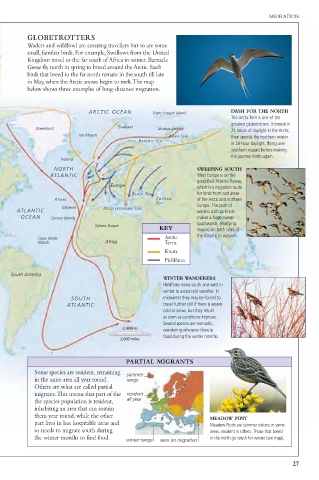
        GLOBETROTTERS
        Waders and wildfowl are amazing travellers but so are some
        small, familiar birds. For example, Swallows from the United
        Kingdom travel to the far south of Africa in winter.Barnacle
        Geese fly north in spring to breed around the Arctic.Such
        birds that breed in the far north remain in the south till late
        in May,when the Arctic snows begin to melt.The map
        below shows three examples of long-distance migration.


                       ARCTIC OCEAN    Franz Joseph Island  DASH FOR THE NORTH
                                                          The Arctic Tern is one of the
                                                          greatest globetrotters. It breeds in
          Greenland           Svalbard  Novaya Zemlya
                                                          24 hours of daylight in the Arctic,
                     Jan Mayan             KARA SEA       then spends the northern winter
                                   BARENTS SEA
                                                          in 24-hour daylight, flying over
                                                          southern oceans before making
                                                          the journey north again.
                Iceland
              NORTH                               SWEEPING SOUTH
              ATLANTIC                            West Europe is on the
                                                  great East Atlantic flyway,
                            Europe                which is a migration route
                                  BLACK SEA       for birds from vast areas
               Azores                   CASPIAN   of the Arctic and northern
                                        SEA       Europe. The path of
                Madeira
     ATLANTIC              MEDITERRANEAN SEA      waders such as Knots
      OCEAN   Canary Islands                      makes a huge sweep
                                                  southwards, emptying
                         Sahara Desert
                                         KEY      regions on both sides of
          Cape Verde                      Arctic   the Atlantic in autumn.
          Islands          Africa         Terns
                                          Knots
                                          Fieldfares
    South America
                                          WINTER WANDERERS
                                          Fieldfares move south and west in
                                          winter to avoid cold weather. In
                   SOUTH                  midwinter they may be forced to
                  ATLANTIC                travel further still if there is severe
                                          cold or snow, but they return
                                          as soon as conditions improve.
                                          Several species are nomadic,
                               2,000km    wandering wherever there is
                                          food during the winter months.
                               2,000 miles
                                PARTIAL MIGRANTS
          Some species are resident, remaining  summer
          in the same area all year round.  range
          Others are what are called partial
          migrants.This means that part of the  resident
          the species population is resident,  all year
          inhabiting an area that can sustain
          them year round, while the other           MEADOW PIPIT
          part lives in less hospitable areas and    Meadow Pipits are summer visitors in some
          so needs to migrate south during           areas, resident in others. Those that breed
          the winter months to find food.  winter range  seen on migration  in the north go south for winter (see map).


                                                                          27

