


Page 36 - Complete Birds of Britain and Europe (DK - RSPB)
P. 36
INTRODUCTION

        ROCKY COASTS, ISLANDS,
        AND THE OPEN SEA
            ost of the European coastline is a “hard” coast of some kind, with    HIGH TIDE REFUGE
        M rocks or cliffs and stony beaches.The majority of these shores are  Even though they feed on muddy
        less attractive to birds than soft estuaries and marshes, but seabirds must  estuaries, waders may move to
                                                          nearby higher rocks when the tide
        still come to land on cliffs and islands in order to breed.  covers the mudflats. The Dunlins
                                                          shown here may be joined by
        ROCKY AND STONY SHORES                            Redshanks, Knots, Bar-tailed
        Stony beaches and wave-washed rocks do see some waders from  Godwits, and Curlews.
        autumn to spring.Typical rocky shore waders are short-billed
        species such as Turnstones and Purple Sandpipers, which feed
        on invertebrate food found among weedy, barnacle-encrusted
        rocks right at the edge of the waves. Knots, Dunlins,
        Curlews, even migrant Common Sandpipers,
        however, often feed around flatter rocks by the
         shoreline. Nearby higher rocks and
          isolated islets out of reach of
            predators offer solid sites for
               nesting gulls and terns.

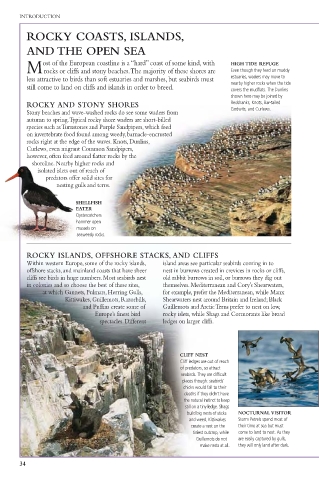
                    SHELLFISH
                    EATER
                    Oystercatchers
                    hammer open
                    mussels on
                    seaweedy rocks.

        ROCKY ISLANDS, OFFSHORE STACKS, AND CLIFFS
        Within western Europe, some of the rocky islands,  island areas see particular seabirds coming in to
        offshore stacks, and mainland coasts that have sheer   nest in burrows created in crevices in rocks or cliffs,
        cliffs see birds in huge numbers. Most seabirds nest   old rabbit burrows in soil, or burrows they dig out
        in colonies and so choose the best of these sites,  themselves. Mediterranean and Cory’s Shearwaters,
            at which Gannets, Fulmars, Herring Gulls,  for example, prefer the Mediterranean, while Manx
                 Kittiwakes, Guillemots, Razorbills,  Shearwaters nest around Britain and Ireland; Black
                      and Puffins create some of  Guillemots and Arctic Terns prefer to nest on low,
                         Europe’s finest bird  rocky islets, while Shags and Cormorants like broad
                          spectacles. Different  ledges on larger cliffs.


                                              CLIFF NEST
                                              Cliff ledges are out of reach
                                              of predators, so attract
                                              seabirds. They are difficult
                                              places though: seabirds’
                                               chicks would fall to their
                                               deaths if they didn’t have
                                               the natural instinct to keep
                                               still on a tiny ledge. Shags
                                               build big nests of sticks  NOCTURNAL VISITOR
                                                and weed, Kittiwakes  Storm Petrels spend most of
                                                create a nest on the  their time at sea but must
                                                 tiniest outcrop, while  come to land to nest. As they
                                                  Guillemots do not  are easily captured by gulls,
                                                   make nests at all.  they will only land after dark.

      34

