


Page 38 - Complete Birds of Britain and Europe (DK - RSPB)
P. 38
INTRODUCTION

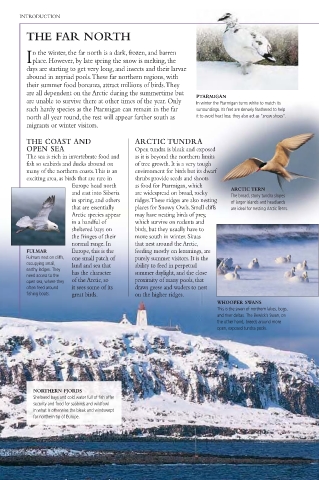
        THE FAR NORTH

         n the winter, the far north is a dark, frozen, and barren
        Iplace. However, by late spring the snow is melting, the
        days are starting to get very long, and insects and their larvae
        abound in myriad pools.These far northern regions, with
        their summer food bonanza, attract millions of birds.They
        are all dependent on the Arctic during the summertime but
                                                  PTARMIGAN
        are unable to survive there at other times of the year. Only  In winter the Ptarmigan turns white to match its
        such hardy species as the Ptarmigan can remain in the far  surroundings. Its feet are densely feathered to help
        north all year round, the rest will appear farther south as  it to avoid heat loss; they also act as “snow shoes”.
        migrants or winter visitors.

        THE COAST AND              ARCTIC TUNDRA
        OPEN SEA                   Open tundra is bleak and exposed
        The sea is rich in invertebrate food and  as it is beyond the northern limits
        fish so seabirds and ducks abound on  of tree growth. It is a very tough
        many of the northern coasts.This is an  environment for birds but its dwarf
        exciting area, as birds that are rare in  shrubs provide seeds and shoots
                   Europe head north  as food for Ptarmigan, which
                                                          ARCTIC TERN
                   and east into Siberia  are widespread on broad, rocky
                                                          The broad, stony tundra slopes
                   in spring, and others  ridges.These ridges are also nesting  of larger islands and headlands
                   that are essentially  places for Snowy Owls. Small cliffs  are ideal for nesting Arctic Terns.
                   Arctic species appear  may have nesting birds of prey,
                   in a handful of  which survive on rodents and
                   sheltered bays on   birds, but they usually have to
                   the fringes of their  move south in winter. Skuas
                   normal range. In  that nest around the Arctic,
        FULMAR     Europe, this is the  feeding mostly on lemmings, are
        Fulmars nest on cliffs,  one small patch of  purely summer visitors. It is the
        occupying small,  land and sea that   ability to feed in perpetual
        earthy ledges. They  has the character   summer daylight, and the close
        need access to the
        open sea, where they  of the Arctic, so   proximity of many pools, that
        often feed around  it sees some of its  draws geese and waders to nest
        fishing boats.  great birds.  on the higher ridges.
                                                       WHOOPER SWANS
                                                       This is the swan of northern lakes, bogs,
                                                       and river deltas. The Bewick’s Swan, on
                                                       the other hand, breeds around more
                                                       open, exposed tundra pools.


         NORTHERN FJORDS
         Sheltered bays and cold water full of fish offer
         security and food for seabirds and wildfowl
         in what is otherwise the bleak and windswept
         far northern tip of Europe.


      36

