


Page 33 - Complete Birds of Britain and Europe (DK - RSPB)
P. 33
WETLANDS

        RESERVOIRS AND LAKES
        Huge numbers of water birds penetrate far inland to  WILDFOWL BONANZA
        take advantage of lakes, which add variety to birdlife in  Lowland reservoirs have great
        otherwise dry areas. Reservoirs with natural shores are  concentrations of wildfowl. In
        excellent, especially if the water level falls, as the mud  winter, huge roosts of gulls
        attracts migrant waders. Flooded gravel workings have  appear as lakes freeze over.
        steep shores and so few waders, but are ideal for ducks.
        The dragonflies found there are food for Hobbies.

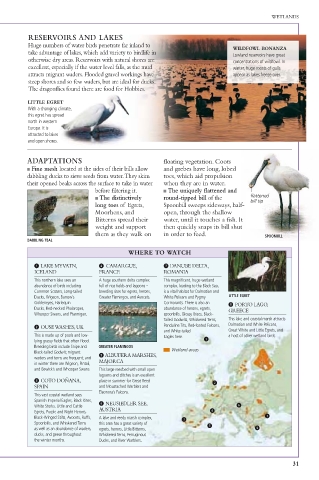
        LITTLE EGRET
        With a changing climate,
        this egret has spread
        north in western
        Europe. It is
        attracted to lakes
        and open shores.
        ADAPTATIONS                       floating vegetation. Coots
         Fine mesh located at the sides of their bills allow  and grebes have long, lobed
        dabbling ducks to sieve seeds from water.They skim  toes, which aid propulsion
        their opened beaks across the surface to take in water  when they are in water.
                         before filtering it.  The uniquely flattened and
                          The distinctively   round-tipped bill of the  flattened
                                                               bill tip
                         long toes of Egrets,  Spoonbill sweeps sideways, half-
                         Moorhens, and    open, through the shallow
                         Bitterns spread their  water, until it touches a fish. It
                         weight and support  then quickly snaps its bill shut
                         them as they walk on  in order to feed.   SPOONBILL
        DABBLING TEAL
                                 WHERE TO WATCH
          1 LAKE MYVATN,  4 CAMARGUE,     7 DANUBE DELTA,
          ICELAND         FRANCE          ROMANIA
          This northern lake sees an  A huge southern delta complex   This magnificent, huge wetland
          abundance of birds including  full of rice fields and lagoons –  complex, leading to the Black Sea,
          Common Scoters, Long-tailed  breeding sites for egrets, herons,  is a vital habitat for Dalmatian and
          Ducks, Wigeon, Barrow’s  Greater Flamingos, and Avocets.  White Pelicans and Pygmy  LITTLE EGRET
          Goldeneyes, Harlequin           Cormorants. There is also an  8 PORTO LAGO,
          Ducks, Red-necked Phalaropes,   abundance of herons, egrets,  GREECE
          Whooper Swans, and Ptarmigan.   spoonbills, Glossy Ibises, Black-
                                          Tailed Godwits, Whiskered Terns,  This lake and coastal marsh attracts
          2 OUSE WASHES,UK                Penduline Tits, Red-footed Falcons,  Dalmatian and White Pelicans,
                                          and White-tailed  Great White and Little Egrets, and
          This is made up of pools and low-  Eagles here.   a host of other wetland birds.
          lying grassy fields that often flood.     1
          Breeding birds include Snipe and  GREATER FLAMINGOS
          Black-tailed Godwit; migrant      Wetland areas
          waders and terns are frequent; and  5 ALBUFERA MARSHES,
          in winter there are Wigeon, Pintail,  MAJORCA
          and Bewick’s and Whooper Swans.  This large reedbed with small open
                          lagoons and ditches is an excellent
          3 COTO DOÑANA,  place in summer for Great Reed  2
          SPAIN           and Moustached Warblers and
                          Eleonora’s Falcons.
          This vast coastal wetland sees
          Spanish Imperial Eagles, Black Kites,
          White Storks, Little and Cattle  6 NEUSIEDLER SEE,  6
          Egrets, Purple and Night Herons,  AUSTRIA   4
          Black-Winged Stilts, Avocets, Ruffs,  A lake and reedy marsh complex,  3  7
          Spoonbills, and Whiskered Terns   this area has a great variety of  5
          as well as an abundance of waders,  egrets, herons, Little Bitterns,  8
          ducks, and geese throughout   Whiskered Terns, Ferruginous
          the winter months.   Ducks, and River Warblers.
                                                                          31

