


Page 35 - Complete Birds of Britain and Europe (DK - RSPB)
P. 35
ESTUARIES AND LOW-LYING COASTS

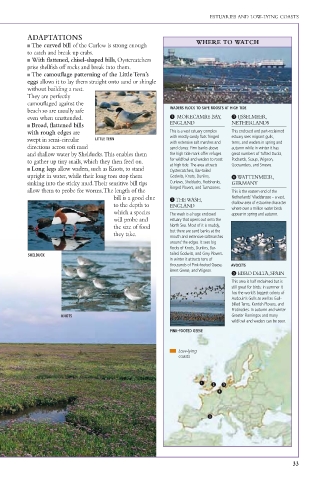
        ADAPTATIONS
         The curved bill of the Curlew is strong enough   WHERE TO WATCH
        to catch and break up crabs.
         With flattened, chisel-shaped bills,Oystercatchers
        prise shellfish off rocks and break into them.
         The camouflage patterning of the Little Tern’s
        eggs allows it to lay them straight onto sand or shingle
        without building a nest.
        They are perfectly
        camouflaged against the
                                           WADERS FLOCK TO SAFE ROOSTS AT HIGH TIDE
        beach so are usually safe
        even when unattended.              1 MORECAMBE BAY,  3 IJSSELMEER,
         Broad, flattened bills            ENGLAND         NETHERLANDS
        with rough edges are               This is a vast estuary complex  This enclosed and part-reclaimed
        swept in semi-circular  LITTLE TERN  with mostly sandy flats fringed  estuary sees migrant gulls,
                                           with extensive salt marshes and
                                                           terns, and waders in spring and
        directions across soft mud         sand dunes. Firm banks above   autumn while in winter it has
        and shallow water by Shelducks.This enables them   the high tide mark offer refuges  great numbers of Tufted Ducks,
        to gather up tiny snails, which they then feed on.  for wildfowl and waders to roost  Pochards, Scaup, Wigeon,
                                                           Goosanders, and Smews.
                                           at high tide. The area attracts
         Long legs allow waders, such as Knots, to stand  Oystercatchers, Bar-tailed
        upright in water, while their long toes stop them  Godwits, Knots, Dunlins,  4WATTENMEER,
        sinking into the sticky mud.Their sensitive bill tips  Curlews, Shelducks, Redshanks,  GERMANY
        allow them to probe for worms.The length of the   Ringed Plovers, and Turnstones.   This is the eastern end of the
                             bill is a good clue  2THE WASH,  Netherlands’ Waddenzee – a vast,
                             to the depth to  ENGLAND      shallow area of estuarine character
                                                           where over a million water birds
                             which a species  The wash is a huge enclosed  appear in spring and autumn.
                             will probe and  estuary that opens out onto the
                             the size of food  North Sea. Most of it is muddy,
                             they take.    but there are sand banks at the
                                           mouth and extensive saltmarshes
                                           around the edges. It sees big
                                           flocks of Knots, Dunlins, Bar-
        SHELDUCK                           tailed Godwits, and Grey Plovers.
                                           In winter it attracts tens of
                                           thousands of Pink-footed Geese,  AVOCETS
                                           Brent Geese, and Wigeon.
                                                           5 EBRO DELTA,SPAIN
                                                           This area is half reclaimed but is
                                                           still great for birds; in summer it
                                                           has the world’s biggest colony of
                                                           Audouin’s Gulls as well as Gull-
                                                           billed Terns, Kentish Plovers, and
                                                           Pratincoles. In autumn and winter
                KNOTS                                      Greater Flamingos and many
                                                           wildfowl and waders can be seen.
                                           PINK-FOOTED GEESE
                                             Low-lying
                                             coasts
                                                   1  2  3
                                                       4

                                                     5


                                                                          33

