


Page 32 - Complete Birds of Britain and Europe (DK - RSPB)
P. 32
INTRODUCTION

        WETLANDS

            etlands include a range of watery habitats, from the
        Wedge of the sea to lakes, reservoirs and lagoons,
        rivers, marshes, and seasonal floods.Water means just one
        thing to birds – abundant food, in the form of fish,
        invertebrates, and plant material.Wetland birds exploit
        these food stocks in innumerable ways: swimming on or
        under water, wading into it, flying over it, or living in
        the dense, upright stems of plants found alongside the
        edge. Unfortunately, many of these habitats have been
        reduced by centuries of drainage and some wetland
        habitats and their birds are under serious threat today.
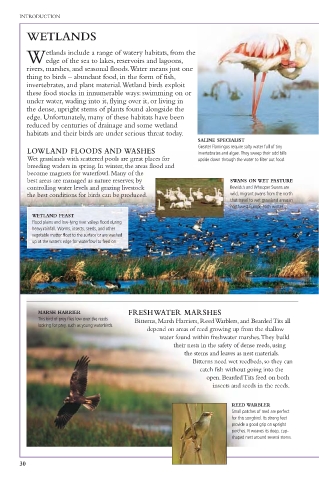
                                                  SALINE SPECIALIST
                                                  Greater Flamingos require salty water full of tiny
        LOWLAND FLOODS AND WASHES                 invertebrates and algae. They sweep their odd bills
        Wet grasslands with scattered pools are great places for  upside down through the water to filter out food.
        breeding waders in spring. In winter, the areas flood and
        become magnets for waterfowl. Many of the
        best areas are managed as nature reserves; by     SWANS ON WET PASTURE
        controlling water levels and grazing livestock    Bewick’s and Whooper Swans are
        the best conditions for birds can be produced.    wild, migrant swans from the north
                                                          that travel to wet grassland areas in
                                                          northwest Europe each winter.
         WETLAND FEAST
         Flood plains and low-lying river valleys flood during
         heavy rainfall. Worms, insects, seeds, and other
         vegetable matter float to the surface or are washed
         up at the water’s edge for waterfowl to feed on.


          MARSH HARRIER          FRESHWATER MARSHES
          This bird of prey flies low over the reeds
                                  Bitterns, Marsh Harriers, Reed Warblers, and Bearded Tits all
          looking for prey, such as young waterbirds.
                                      depend on areas of reed growing up from the shallow
                                         water found within freshwater marshes.They build
                                            their nests in the safety of dense reeds, using
                                               the stems and leaves as nest materials.
                                                 Bitterns need wet reedbeds,so they can
                                                   catch fish without going into the
                                                    open.Bearded Tits feed on both
                                                      insects and seeds in the reeds.

                                                           REED WARBLER
                                                           Small patches of reed are perfect
                                                           for this songbird. Its strong feet
                                                           provide a good grip on upright
                                                           perches. It weaves its deep, cup-
                                                           shaped nest around several stems.


      30

