


Page 34 - Complete Birds of Britain and Europe (DK - RSPB)
P. 34
INTRODUCTION

        ESTUARIES AND LOW-LYING COASTS

          river broadening towards the sea deposits mud and
        Asilt over vast areas that are exposed at low tide.The
        sides of such an estuary and other stretches of soft coast
        consolidate into salt marshes, where muddy creeks
        wind through green swards of salt-tolerant vegetation.
        Sand dunes, shingle spits, shell banks, and sand or pebble
        beaches all provide habitats for birds on low-lying shores.

        ESTUARIES
        A muddy estuary is an excellent
        source of food for numerous birds
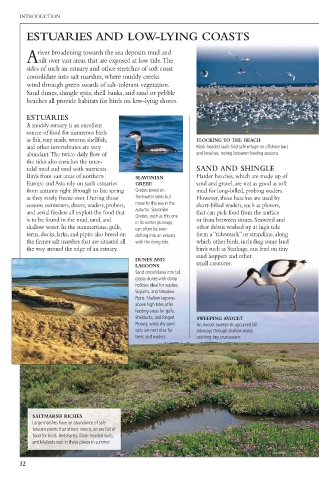
        as fish, tiny snails, worms, shellfish,   FLOCKING TO THE BEACH
        and other invertebrates are very          Black-headed Gulls find safe refuge on offshore bars
        abundant.The twice-daily flow of          and beaches, resting between feeding sessions.
        the tides also enriches the inter-
        tidal mud and sand with nutrients.        SAND AND SHINGLE
        Birds from vast areas of northern  SLAVONIAN  Harder beaches, which are made up of
        Europe and Asia rely on such estuaries   GREBE  sand and gravel, are not as good as soft
        from autumn right through to late spring   Grebes breed on  mud for long-billed, probing waders.
        as they rarely freeze over. During those  freshwater lakes but  However, these beaches are used by
        seasons swimmers, divers, waders, probers,  move to the sea in the  short-billed waders, such as plovers,
        and aerial feeders all exploit the food that   autumn. Slavonian  that can pick food from the surface
                                   Grebes, such as this one
        is to be found in the mud, sand, and  in its winter plumage,  or from between stones. Seaweed and
        shallow water. In the summertime, gulls,  can often be seen  other debris washed up at high tide
        terns, ducks, larks, and pipits also breed on  drifting into an estuary  form a “tidewrack” or strandline, along
        the firmer salt marshes that are situated all  with the rising tide.  which other birds, including some land
        the way around the edge of an estuary.    birds such as Starlings, can feed on tiny
                                                  sand hoppers and other
                                   DUNES AND
                                   LAGOONS        small creatures.
                                   Sand consolidates into tall,
                                   grassy dunes with damp
                                   hollows ideal for waders,
                                   Skylarks, and Meadow
                                   Pipits. Shallow lagoons
                                   above high tides offer
                                   feeding areas for gulls,
                                   Shelducks, and Ringed  SWEEPING AVOCET
                                   Plovers, while dry sand  An Avocet sweeps its upcurved bill
                                   spits are nest sites for   sideways through shallow water,
                                   terns and waders.  catching tiny crustaceans.


         SALTMARSH RICHES
         Large marshes have an abundance of salt-
         tolerant plants that attract insects, so are full of
         food for birds. Redshanks, Black-headed Gulls,
         and Mallards nest in these places in summer.


      32

